
A pure sequence is a group, not the whole declaration
This guide uses 13-card Indian Rummy examples. A natural run uses at least three consecutive cards of one suit without a joker substituting a missing card. Recognising one run is only the first check: the rest of the hand must also be arranged legally under the table’s declaration rules. The examples are card puzzles, not a claim about the live rules of any APK offered by this site.
Four groups that look similar
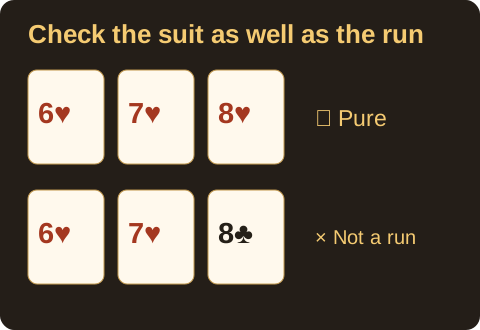
6♥ 7♥ 8♥ is a pure sequence. 6♥ 7♥ 8♣ is not a same-suit sequence. 6♥ 8♥ 9♥ is not consecutive because 7♥ is missing. 6♥ 7♥ PJ can be an impure sequence if the printed joker represents 8♥; it does not become pure merely because its represented card has the right suit. Write both the actual cards and any substitution.
Three cards are a minimum, not a maximum
4♣ 5♣ 6♣ 7♣ is one four-card pure sequence. Do not split it into two overlapping runs that both use the same 5♣ or 6♣. Two physical copies in a multi-deck game are different from counting one physical card twice. In an exercise, lay out the groups separately so every card has exactly one job.
Ace works at an end, not around a corner
In the stated example convention, A♦ 2♦ 3♦ and Q♠ K♠ A♠ are natural runs. K♥ A♥ 2♥ is not a run: the Ace cannot connect the high and low ends at once. This is not the Teen Patti question of which Ace sequence ranks higher. Rummy asks whether the cards form a valid group.
A full 13-card grouping to count
Arrange 4♣ 5♣ 6♣ 7♣ / 9♥ 10♥ J♥ / 2♠ 2♥ 2♦ / K♠ K♥ K♦. The groups contain 4 + 3 + 3 + 3 = 13 physical cards. There are two natural sequences and two three-suit sets. Replacing J♥ with an ordinary Q♥ would break the second sequence; the first pure run alone would not repair that gap.
A wild-rank card needs a rule check
A card selected as a wild rank may also appear in its own natural position. Rule descriptions differ over how that use is classified. Do not assume that an 8♠ inside 7♠ 8♠ 9♠ counts as pure when eights are designated wild. Check the exact table’s treatment first. The unambiguous examples above assume none of their natural cards is designated wild.
Two quick checks
Is 8♦ 9♦ 10♦ J♦ pure if none of those ranks is wild?
Reveal the answer and reason
Yes: four consecutive natural cards in one suit. It counts as one sequence, not two.
Does 5♣ 5♦ 5♥ satisfy the pure-sequence requirement?
Reveal the answer and reason
No. It is a set: equal ranks, different suits. A valid set is useful, but it does not replace a required sequence.
From recognising groups to making decisions
Check suit, consecutive ranks, substitution and physical card count in that order. Then check the whole declaration, rather than pressing a button because one group looks complete. A penalty or scoring cap is format-specific; do not import a number from another app. Practise without account details or money.
Read the full Rummy guide · Practise draw and discard choices · Compare scoring formats
For a worked follow-up, read Rummy Invalid Declaration: Find the Mistake in These 8 Hands.