
Read the group before naming it
In 13-card Indian Rummy, a set groups equal ranks in different suits; a sequence groups consecutive ranks in one suit. The distinction matters because a set cannot stand in for a required sequence. This article concentrates on group classification, duplicate-suit mistakes and physical card counting. It complements the pure-sequence guide rather than repeating the full game or scoring rules. None of the examples is a tested app screenshot.
Compare these four small groups
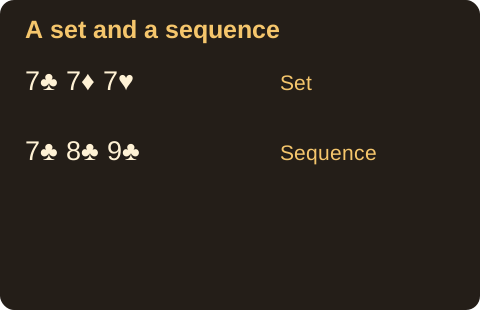
7♣ 7♦ 7♥ is a natural three-card set. 7♣ 8♣ 9♣ is a natural sequence if those ranks are not designated wild. 7♣ 7♦ 8♥ is neither: it has unequal ranks and no same-suit run. 7♣ 8♦ 9♥ is consecutive in rank but not a Rummy sequence because the suits differ. A Teen Patti mixed-suit sequence is a different rule, so do not transfer that category into Rummy.
Two copies do not create two suits
A multi-deck game may give you two physical 7♣ cards. Under the different-suit set convention used here, 7♣ 7♣ 7♥ is not a valid natural set. The two clubs are physically different cards but have the same suit. In contrast, 7♣ 7♦ 7♥ 7♠ uses four distinct suits and is a natural four-card set. Confirm the chosen variant before applying this restriction to another form of Rummy.
A joker completes a job, not every job
In 9♣ 9♦ PJ, let the printed joker represent 9♥. That produces a set in this practice model. In 9♣ 10♣ PJ, let it represent J♣; that produces an impure sequence. The same printed card is doing different work. Neither arrangement is a natural pure sequence. Restrictions on joker counts or oversized sets depend on the platform, so the examples use only one substitute and three-card groups.
Check one full 13-card declaration
Use 3♠ 4♠ 5♠ 6♠ / 8♥ 9♥ 10♥ / Q♣ Q♦ Q♥ / 2♣ 2♦ 2♥. The groups contain 4 + 3 + 3 + 3 = 13 cards, with two natural sequences and two sets. Now swap Q♦ for a second Q♣: the total is still 13, but the queen group violates this article’s different-suit set convention. Correct card count alone does not make the groups legal.
One physical card cannot serve twice
Suppose you hold 5♦ 6♦ 7♦ 7♣ 7♥. The diamond seven could support the run or the sevens set, but the five cards cannot form both complete groups simultaneously. A sixth card such as 7♠ would allow 5♦ 6♦ 7♦ / 7♣ 7♥ 7♠. Write the actual card allocations, not two attractive groups sharing one card. This explains why drawing a helpful card can change the whole arrangement.
Two practice checks
Is J♠ J♥ J♦ a sequence?
Reveal the explanation
No. Equal ranks and different suits make it a set. A valid set still does not satisfy a required sequence.
Can 4♥ 5♥ 6♥ 6♣ 6♦ be written as two completed groups?
Reveal the explanation
Not with only those five cards. Both proposed groups need the single 6♥. A sixth 6♠ would supply a separate third six for the set.
Use the group checklist
Ask: same rank or consecutive rank? Different suits or one suit? Is anything substituting? Have I reused a physical card? Then check the whole hand against the selected mode. Practise with cards or counters without money; this guide does not certify an app, calculate every penalty or promise a winning draw.
For a worked follow-up, read Rummy Invalid Declaration: Find the Mistake in These 8 Hands.