
A drop is a recorded exit, not a missing card
A Rummy drop ends participation in a deal under the selected format’s rules. It is different from discarding one card, declaring an arranged hand, closing a browser tab or losing a connection. The important question for this guide is what gets written on the score sheet after an exit—not whether somebody should gamble on another draw. All examples are paper exercises with no money.
Declare the scoring model first
For these exercises only, first drop records 20 points and middle drop records 40. Similar labels appear in published RummyCircle material, but eligibility varies by format and player count. Its dated rules also distinguish some two-player Deals games from other tables. These numbers are not verified settings of the APK linked by this website. Read the selected room’s exit rules before using them.
The stage matters more than the clock
Imagine three labelled moments: before your first draw; after you have taken a turn; during a later turn before drawing. A model may allow an early drop at the first moment, classify the later exit differently, or make the button unavailable after a draw. “I left within ten seconds” does not identify the rule stage. Record the action history instead of using elapsed time as proof.
A four-deal score ledger
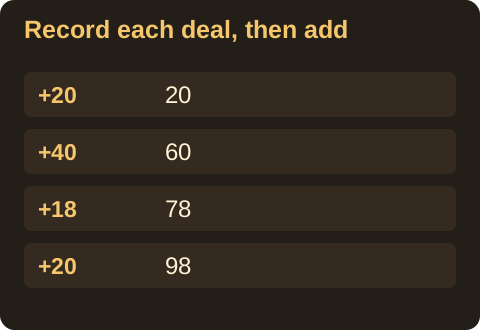
Start the practice total at 0. Deal 1: first drop, add 20, total 20. Deal 2: middle drop, add 40, total 60. Deal 3: an independently established hand result of 18, total 78. Deal 4: first drop, add 20, total 98. The arithmetic is 20 + 40 + 18 + 20 = 98. The value 18 is an assumed result, not a penalty calculated from an undisplayed hand.
Fixed exit score and unmatched-card score are different
If this model records a 20-point first drop, do not replace it with the sum of the cards you happen to hold. Conversely, a normal hand loss is not automatically a 40-point middle drop. Label each row by its cause before adding it. A displayed cap also needs its own scope: a per-hand limit does not cap the running total of several hands at the same number.
Disconnection is not a reliable drop shortcut
Closing an app may leave a session active or let a timer continue. Do not assume it invokes the same exit as a confirmed Drop action. Record what the interface actually showed, the time and the deal identifier if available. Protect private account details when asking support. This article cannot establish the live timeout policy of a particular service or promise a score correction.
Check your score reading
The total is 35 and a valid middle drop adds 40 in this model. What is the new total?
Reveal the explanation
75. It is not 40: the new deal result is added to the existing running total.
You close the phone screen before your first turn. Does that prove a 20-point exit?
Reveal the explanation
No. Screen state does not establish a confirmed drop or the table’s rules. Check the recorded deal outcome rather than assuming.
Keep one rule set per score sheet
Write the format and exit policy at the top of the worksheet. Do not mix Points, Pool and Deals rules because the labels sound familiar. Practising the bookkeeping does not require an account, deposit or a new APK.