
999 changes the comparison
In this worked model, three card values become three digits. Arrange them to make the largest number, then compare how far each result lies below 999. Do not add the digits or apply ordinary Trail-to-High-Card rankings. Suits do not decide these examples. The model below uses no jokers; a mode that adds wild cards needs its own substitution rules.
Write the value key first
Use this explicit practice key: Ace = 1; 2–9 keep their number; 10, J, Q and K = 0. This is a declared convention for the examples, not a promise about every app labelled 999. Before a real table, check the displayed mapping, whether rearrangement is permitted, joker treatment and equal-score settlement. If no mapping is supplied, do not infer it from a different game.
All six arrangements of one hand
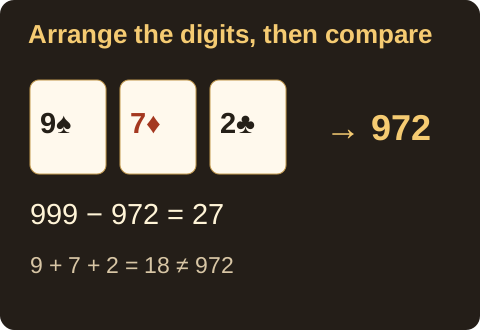
For 9♠ 7♦ 2♣ the arrangements are 972, 927, 792, 729, 297 and 279. The largest is 972. Its distance from the target is 999 − 972 = 27. Adding 9 + 7 + 2 gives 18, which answers a different question. Put the greatest digit in the hundreds place, then the next greatest in the tens place.
Six hands, with their distances
9♣ 9♦ 9♥ → 999, distance 0. 9♠ 9♥ 8♦ → 998, distance 1. 9♦ 8♣ 7♥ → 987, distance 12. 9♥ 7♣ 2♦ → 972, distance 27. 8♠ 8♦ K♣ → 880, distance 119. A♠ Q♥ 2♣ → 210, distance 789. Each row uses the same value key. A face card is a zero digit here, not a reason to apply standard high-card strength.
Compare the number, not the familiar shape
A player sees 8♠ 8♥ K♦ and calls it a pair with a king. Another has 9♣ 7♦ 2♥ with no standard combination. Their 999 results are 880 and 972, so the second hand is closer. That does not change the ordinary Teen Patti ranking chart; it means this format asks a different task. Keep the two rule sheets separate.
Try two comparisons
Which is closer: 9♠ 8♦ 3♣ or 9♥ 7♣ 7♦?
Reveal the answer and reason
983 beats 977: the distances are 16 and 22. The pair of sevens does not receive a category bonus.
9♠ 8♥ A♦ versus 9♣ A♠ 8♦: does a suit decide?
Reveal the answer and reason
Both form 981. They are equal under this numerical model. Use the stated tie rule; do not invent a suit hierarchy.
Use a written check before the next hand
Write the three digit values, arrange them, calculate the distance and compare. Keep the exercise counter-only and stop if the rules are unclear. No example predicts which cards will be dealt or guarantees a result.