
Four dealt, three evaluated
Best of Four gives four cards but evaluates a chosen three-card hand. There are exactly four choices: leave out the first, second, third or fourth card. This article uses ordinary Teen Patti categories without jokers. Pick the best legal three, not the highest four-card total. Availability, selection timing and discarded-card visibility depend on the actual mode.
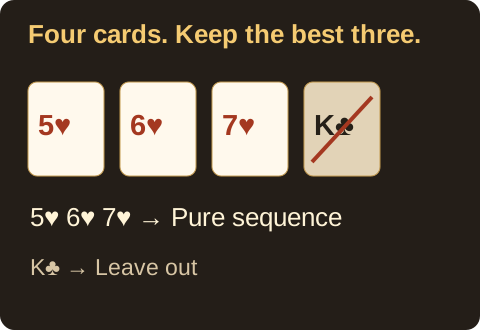
A king can be the card to leave out
Deal: 5♥ 6♥ 7♥ K♣. Leaving out K♣ gives 5♥ 6♥ 7♥, a pure sequence. Leaving out 7♥ gives 5♥ 6♥ K♣, a high-card hand. Leaving out 6♥ gives 5♥ 7♥ K♣, also high card. Leaving out 5♥ gives 6♥ 7♥ K♣, again high card. The pure sequence wins the selection comparison even though it has no king.
Two pairs do not become a three-card category
Deal: Q♠ Q♥ 8♣ 8♦. Q♠ Q♥ 8♣ and Q♠ Q♥ 8♦ both give a pair of queens with an eight kicker. Q♠ 8♣ 8♦ and Q♥ 8♣ 8♦ give a pair of eights with a queen kicker. Choose the queens. You cannot submit all four cards and claim “two pair” under this three-card ranking model. The suit of the spare eight does not improve the pair.
Keep the card that improves the kicker
Deal: J♠ J♥ A♣ 2♦. The two selections containing both jacks are pair-J with Ace and pair-J with 2. The Ace kicker is stronger. The other two selections each contain only one jack and no sequence or colour, so they are high-card hands. Here keeping the Ace is right because it improves the best category, not simply because Aces always have to stay.
Aces require the table convention
Deal: A♠ 2♥ 3♦ K♣. A♠ 2♥ 3♦ is a sequence if A-2-3 is accepted. The selections with K♣ do not make K-A-2 a valid run in the ordinary model. This hand alone does not settle where A-2-3 ranks against another sequence; check that convention separately. A four-card deal does not remove rule ambiguity.
Choose before revealing
From 9♦ 10♦ J♦ J♣, which card should be left out?
Reveal the answer and reason
Leave out J♣. The remaining diamond run is a pure sequence. Keeping both jacks makes a pair, which ranks below it. Listing all four selections prevents a familiar pair from hiding the better run.
A repeatable selection routine
List all four subsets, label each category, compare categories, then apply tie-breakers within the best one. Do not redraw or add a joker unless the chosen mode explicitly permits it. Practise face-up with counters; this explains card selection rather than predicting other players or recommending a stake.