

Watch the hand comparison
Read the explanation
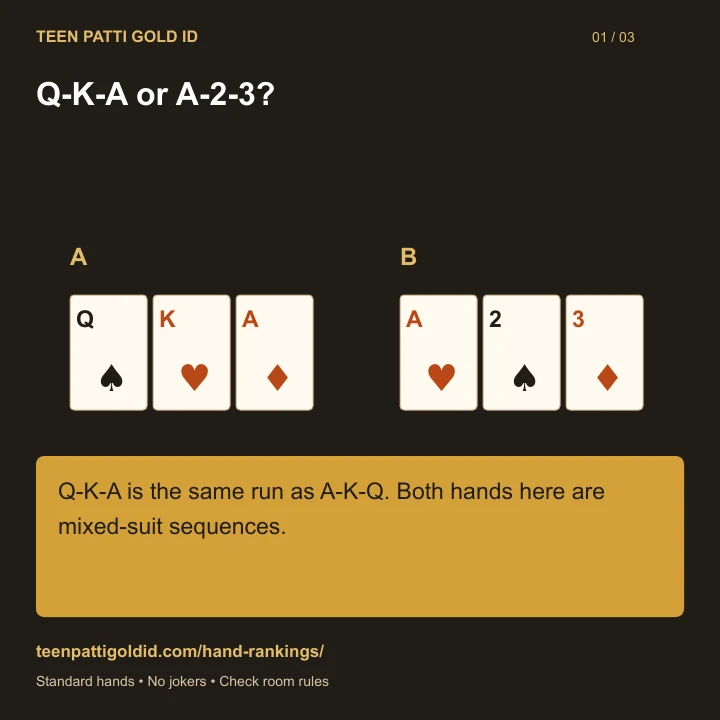
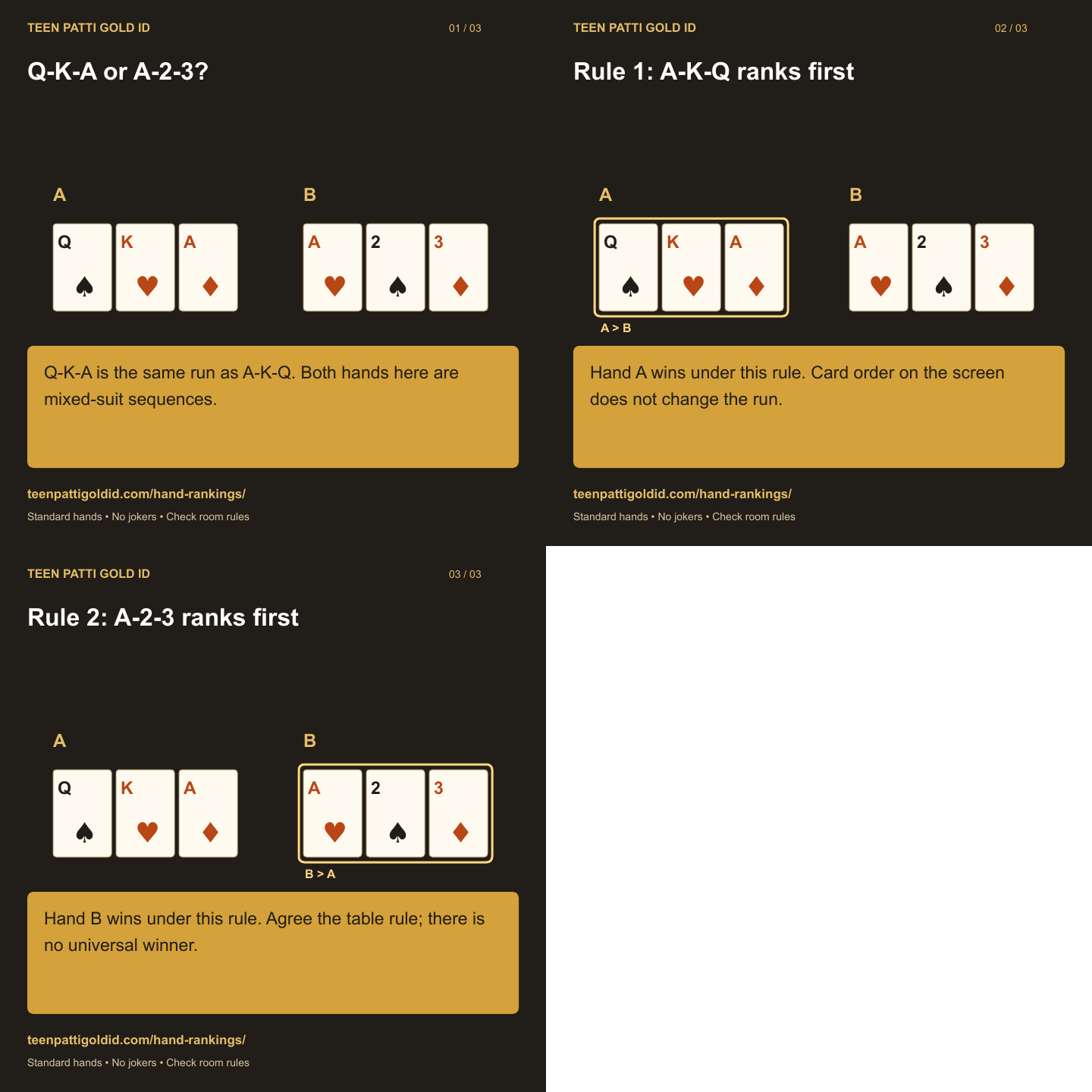
- Q-K-A or A-2-3?
Q-K-A is the same run as A-K-Q. Both hands here are mixed-suit sequences.
- Rule 1: A-K-Q ranks first
Hand A wins under this rule. Card order on the screen does not change the run.
- Rule 2: A-2-3 ranks first
Hand B wins under this rule. Agree the table rule; there is no universal winner.
Download GIF · Download still image · Try 10 practice questions
Use the rule for the exact mode
Pagat puts A-2-3 first. The standard-game introduction on Octro’s rules page puts A-K-Q first; later sections describe other modes. Neither source establishes the rule for every Teen Patti Gold table.
To dispute a result, keep the two hands, game mode and round reference together. “I had A23” alone leaves out whether the hand was suited and which ranking applied. For the complete category chart, use the hand-ranking reference.
Quick A23 vs AKQ Answer
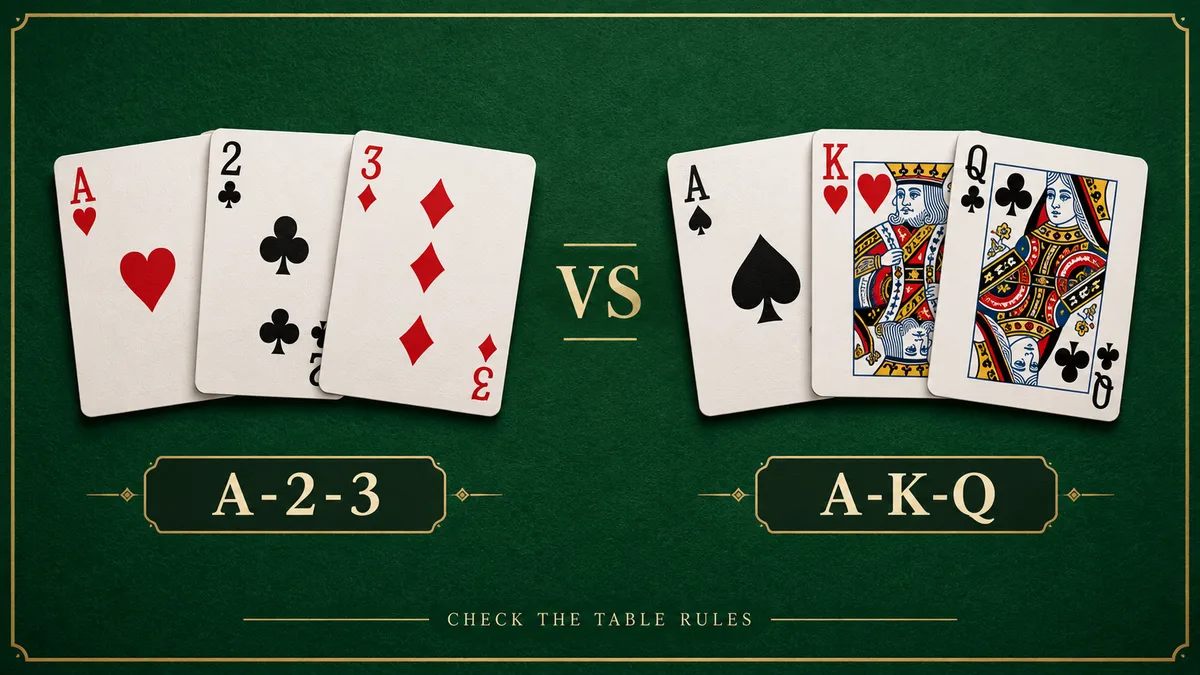
| Table rule | Higher sequence | Next sequence |
|---|---|---|
| A-2-3-high convention | A-2-3 | A-K-Q |
| A-K-Q-high convention | A-K-Q | A-2-3 |
| Special variation | Determined by variation rules | Do not assume standard order |
If the table does not state the order and players are using physical cards, agree on the rule before dealing.
A different question is whether Q-K-A counts as a run at all. See why QKA is a sequence; the A23 comparison here decides the order between two valid runs.
Worked Example 1: Both Hands Are Pure Sequences
Player A holds A♥-2♥-3♥.
Player B holds A♠-K♠-Q♠.
Both hands are Pure Sequences because each contains three consecutive ranks in one suit. The winner depends entirely on the table’s published ordering.
Under A-2-3-high rules, Player A wins. Under A-K-Q-high rules, Player B wins.
The suit does not normally decide the result. Hearts do not automatically beat spades, and spades do not automatically beat hearts unless the table explicitly introduces suit ranking.
Worked Example 2: Pure Sequence vs Sequence
Player A holds A♥-2♥-3♥.
Player B holds A♠-K♦-Q♣.
Under the standard category hierarchy, Player A wins regardless of whether A23 or AKQ ranks higher within its category. Player A has a Pure Sequence, while Player B has an ordinary Sequence.
The stronger category is decided before comparing which series of ranks is higher.
Worked Example 3: Both Hands Are Ordinary Sequences
Player A holds A♥-2♣-3♦.
Player B holds A♣-K♥-Q♦.
Both hands are mixed-suit Sequences. Under A23-high rules, Player A wins. Under AKQ-high rules, Player B wins.
This is the situation in which failing to agree on the sequence order can create a direct dispute.
Does Suit Break an A23 vs AKQ Tie?
Normally, the suit does not make one sequence higher than another. If two players hold the same sequence ranks in the same category, the result follows the table’s tie rule.
For example, A♠-K♠-Q♠ and A♥-K♥-Q♥ are equal-ranked Pure Sequences under a system without suit ranking. A table may split the pot, award it according to who requested the show, or apply another house procedure.
Do not invent a spades-over-hearts rule unless it is displayed by the table.
How to Check the Rule in Teen Patti Gold
Before entering a table, open its information or rules panel. Look for Hand Ranking, Sequence Order, How to Play or a question-mark icon.
Check whether the ranking display explicitly places A23 above AKQ or the reverse. Do not rely on a screenshot from another app, an old version or a special variation.
For private tables, tell friends which order will be used before play begins. A simple agreement such as “AKQ first, then A23” prevents confusion later.
If the current Teen Patti Gold screen does not state the order clearly, use the in-app support path and include the exact variation and app version in the question.
Sources
References above checked on 21 September 2026.