

Watch the hand comparison
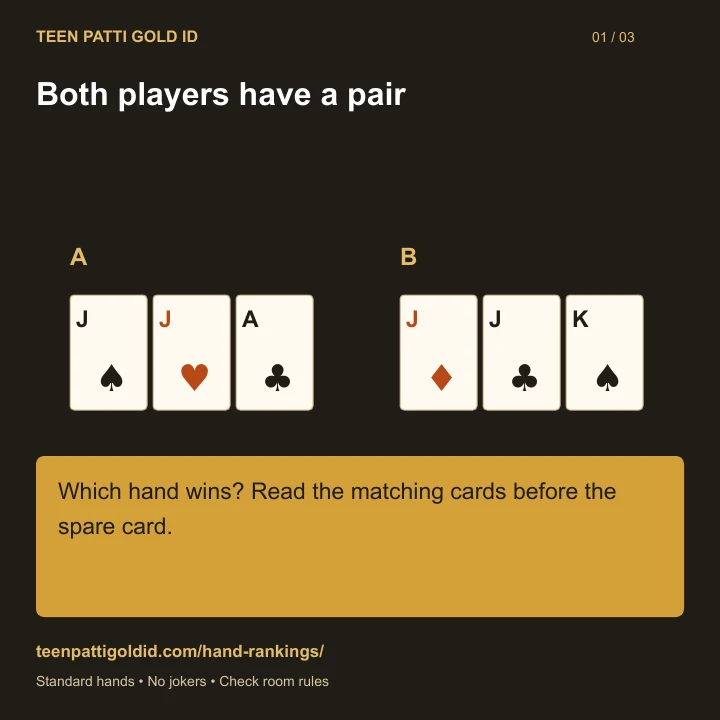
Read the explanation
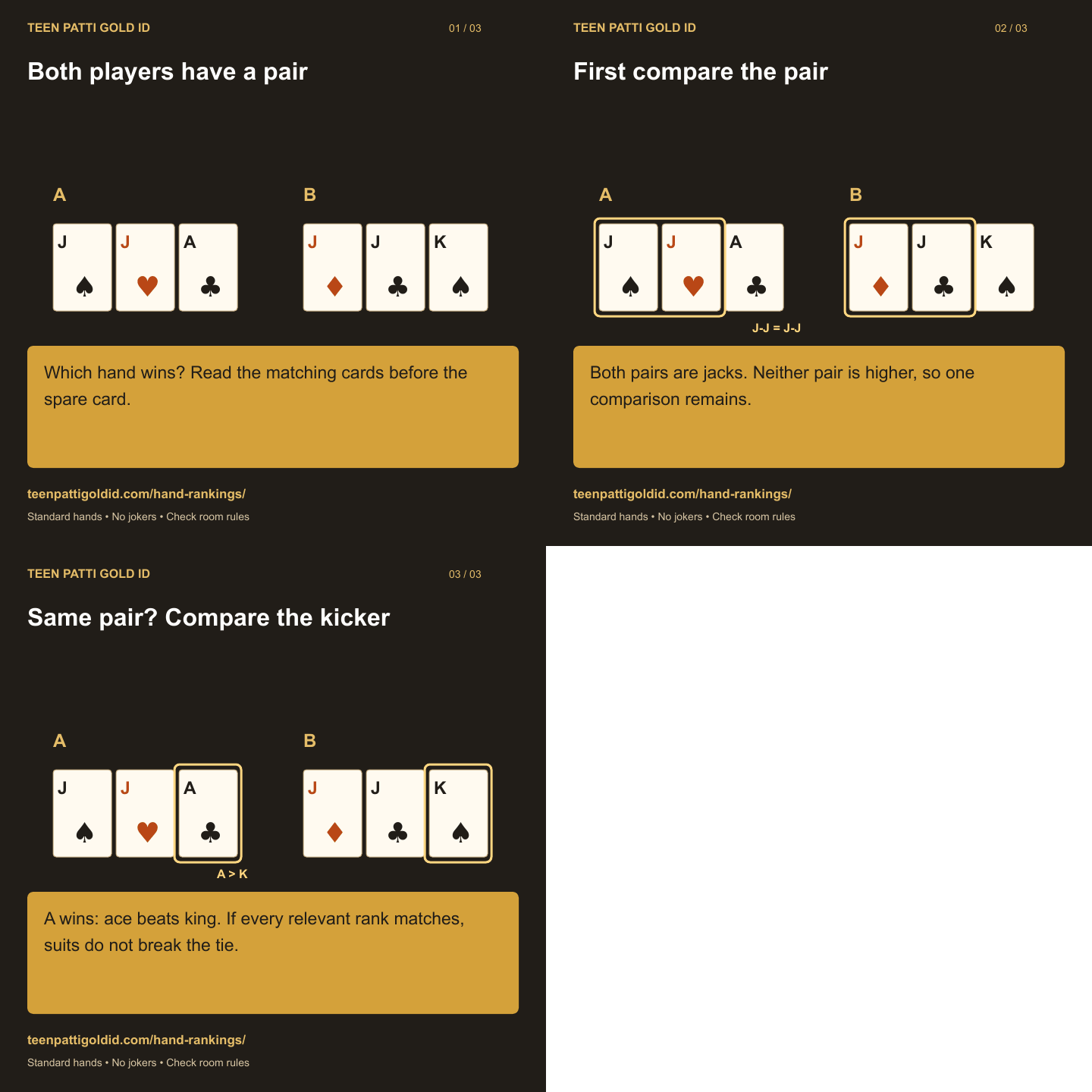
- Both players have a pair
Which hand wins? Read the matching cards before the spare card.
- First compare the pair
Both pairs are jacks. Neither pair is higher, so one comparison remains.
- Same pair? Compare the kicker
A wins: ace beats king. If every relevant rank matches, suits do not break the tie.
Download GIF · Download still image · Try 10 practice questions

The examples below use one 52-card deck, no jokers and no suit-based tiebreaker. Each row is an independent deal. These assumptions matter: wild cards, multiple decks or a special mode can change which equal hands are possible and how they are settled.
Use three checks in this order
First compare categories: trail, pure sequence, sequence, colour, pair, high card. A stronger category wins before individual high cards matter. Second compare the relevant ranks within the shared category. Third, only when those ranks are identical, check the rule that settles an exact tie.
| Shared category | Compare first | Compare next if necessary |
|---|---|---|
| Trail | Rank of the three matching cards | No kicker exists |
| Pure sequence | Sequence position in the agreed order | Suit does not decide under our assumptions |
| Sequence | Sequence position in the agreed order | Mixed suits do not provide a tiebreaker |
| Colour | Highest card | Middle card, then lowest card |
| Pair | Rank of the pair | The third card, called the kicker |
| High card | Highest card | Middle card, then lowest card |
Do not add the numerical values of the cards. Teen Patti comparison is ordered, not a points total. A♣ 7♦ 3♥ has a higher top card than K♣ Q♦ 9♥ even though adding numbers might suggest a different result; neither hand forms a stronger category here.
Same pair: the kicker matters only after the pair
Compare 9♣ 9♦ A♠ with 9♥ 9♠ K♦. Both players have nines, so compare the remaining cards. Ace beats king; the first hand wins. Calling this a tie just because both pairs are nines skips a necessary comparison.
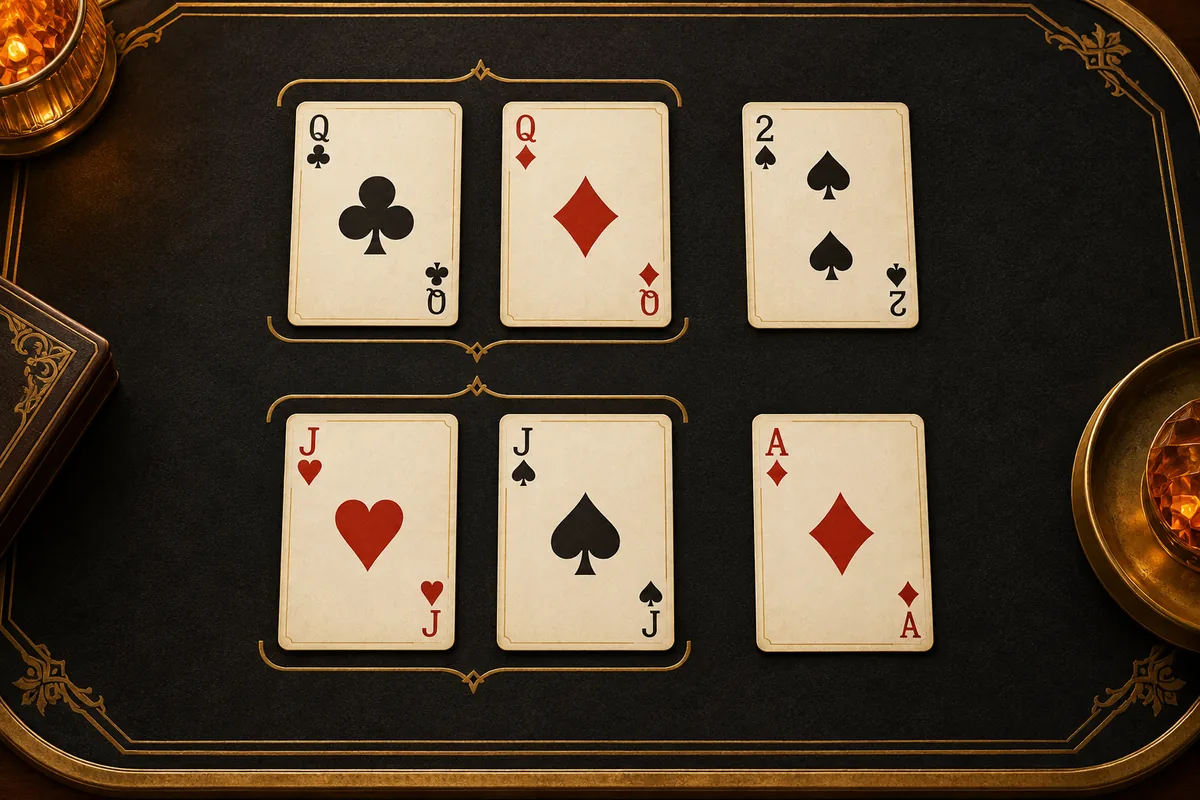
Now compare Q♣ Q♦ 2♠ with J♥ J♠ A♦. Queens beat jacks, so the first hand wins immediately. The second player's ace is irrelevant because the paired ranks are different.
An exact pair tie is possible in a single deck: 9♣ 9♦ A♠ against 9♥ 9♠ A♥. All six physical cards are distinct, and both hands evaluate as a pair of nines with an ace kicker. Under a no-suit rule, the hand comparison stops there. It does not yet decide how the pot is awarded.
Same colour: compare all three ranks in order
Sort each colour from high to low. Compare A♥ J♥ 7♥ with A♣ 10♣ 9♣. The aces match; jack beats ten, so hearts win at the second comparison. The club nine cannot compensate for its lower middle card.
For A♥ J♥ 7♥ against A♣ J♣ 6♣, the first two ranks match. Seven beats six at the third comparison. This is still a win, not a tie.
For A♥ J♥ 7♥ against A♣ J♣ 7♣, all three ranks match. These are equal colours under the assumptions here. Hearts do not beat clubs merely because of their symbol. If a table ranks suits, that needs to be an explicit rule before the deal.
Same sequence: settle the ace order first
Two ordinary sequences with the same ranks are equal under a no-suit rule. For example, 8♣ 9♦ 10♥ and 8♦ 9♠ 10♣ are both ten-high sequences. They use six different cards and neither is a pure sequence.
But 8♥ 9♥ 10♥ beats 8♣ 9♦ 10♠: the first is a pure sequence, a higher category. Matching ranks do not erase the category difference.
A23 versus AKQ is a separate rules question, not an exact tie. Octro's published guide lists AKQ first in its classic section but A23 first in its 6 Patti section. That is a reason to identify the mode before comparing aces—not to apply one section's order to every table. Read our A23 versus AKQ guide for the two possible orders. KA2 is not treated as a sequence in these examples.
An exact tie does not always mean a split pot
An equal hand and an equal payout are different things. A game may use a requester rule, a split-pot rule or a mode-specific settlement. You need the instruction for the actual action that ended the round.
For example, TeenPatti Royale's official help says that an exact tie in a show is lost by the requester. Its sideshow description instead has the other player pack when the requester's cards are equal or better. These are product-specific instructions for different actions; they are not universal Gold rules.
Octro's Hi-Lo variation also distinguishes a requested show from a forced reveal at the pot limit. That is another reason a one-line claim such as “all ties split” is unreliable. If playing physical cards, agree on a settlement rule in advance. The offline practice guide uses splitting as its own stated house rule.
When an app result surprises you, record the mode name, your three cards, the other revealed cards and whether it was show, sideshow or an automatic reveal. Hide player identifiers before sharing a screenshot publicly. For a Gold-specific issue, use the support contact guide rather than treating another publisher's rule as decisive evidence.
Avoid examples that cannot happen in one deck
Two players cannot both hold a natural trail of kings in the same deal from one standard deck: that would need six kings, but the deck has four. Likewise, two players cannot both hold the exact physical cards A♥ K♥ Q♥. A screenshot or example suggesting this needs context such as wild cards, multiple decks or separate rounds.
Equal-ranked hands can still be possible. A♥ K♥ Q♥ and A♣ K♣ Q♣ are different physical cards and equal pure sequences under a no-suit rule. The equal-pair example above uses all four nines and two different aces, so it is also possible.
Practise with the comparison tool
Open the hand comparison tool and enter the two pair-of-nines hands with different kickers. Then change the king kicker to an ace of another suit. The comparison changes from a win to a hand tie.
The tool evaluates ordinary cards and lets you select an ace-sequence order. It does not know who requested show or what an app's settlement policy is. Use its result for the hand comparison, then apply the table's pot rule separately. Keep the same physical card out of both hands.
Frequently asked questions
Does the highest suit win a tie?
Not under the no-suit rules used here. If your table has a suit order, confirm it explicitly; do not infer it from the display order of suit icons.
Is the pot divided when both players have a pair?
Only having a pair is insufficient. Compare the pair ranks, then the kickers. Even an exact hand tie still needs the table's settlement rule.
Does the player who requests show always lose a tie?
That is a documented rule in some games, not a universal rule for every mode and action. Sideshow and automatic reveals may be handled differently.
Can this guide decide a joker tie?
It explains the comparison process, but its worked hands are natural. First evaluate each wild hand under the selected joker rules, then check any special tie conditions for that mode.
Sources
Rule and product references checked on 24 September 2026.