

Guide updated:
Blind and seen are states, not hand types
A player starts the round with three face-down cards. If you continue without looking, you are blind. Once you view the cards, you become seen for the rest of that hand; you do not normally switch back to blind.
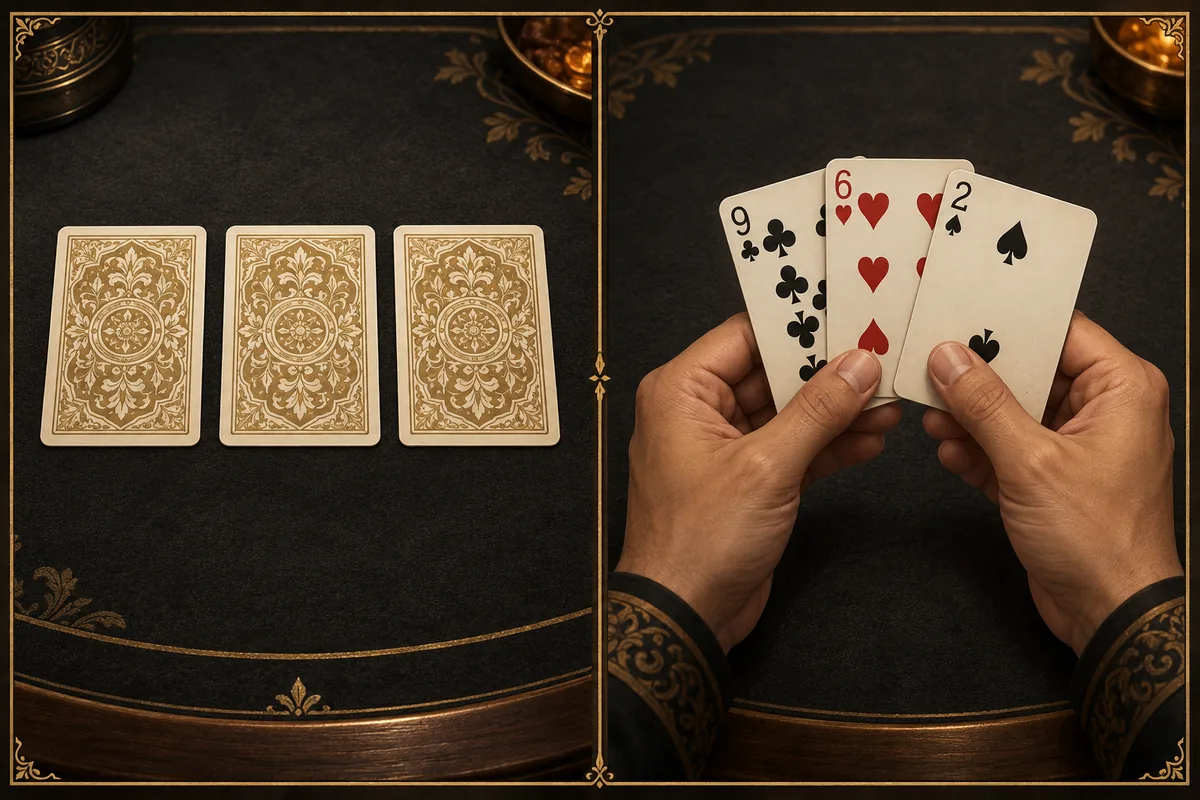
The distinction affects information and often the permitted contribution. A blind player knows less about the hand but may be allowed to continue at a different chip amount. A seen player knows the cards but follows the seen-player range displayed by the table. There is no universal multiplier that applies to every home game or app room.
Being blind does not make a weak hand stronger, and being seen does not reveal your cards to opponents. These labels describe what you have viewed and which action rules apply.
| State | What you know | What usually changes |
|---|---|---|
| Blind | You have not opened the three cards | Blind contribution range and uncertainty |
| Seen | You have viewed your own hand | Seen contribution range; sideshow may become available |
| Packed | You have left the current round | No more actions and no claim on that pot |
If a mode keeps cards hidden until a particular limit, compare its rules with Potblind: when cards open and how pot limits work. Blind play alone does not establish the Potblind rules.
Blind vs seen: how much is the chaal?
The following teaching model uses Pagat’s published rules, checked on 26 September 2026. It uses counters with no cash value, not verified Teen Patti Gold room settings.
Boot is each player’s opening contribution. Current stake (S) is the reference amount for the next action. Pot is the accumulated total. A pot of 140 does not mean the next player must contribute 140.
| Player state | Contribution | If S = 20 | Next S |
|---|---|---|---|
| Blind | S to 2S | 20 to 40 counters | The amount contributed |
| Seen | 2S to 4S | 40 to 80 counters | Half the amount contributed |
For example, a seen contribution of 40 leaves S at 20; it does not raise S to 40. These are ordinary chaal contributions. The separate show cost appears below.
Read a turn as a decision map
Instead of memorising disconnected terms, ask three questions in sequence.
- Have you looked?No means you are blind; yes means you are seen. That status controls which amount and comparison options the table presents.
- Continue or leave?Continue with the permitted stake—often described as a chaal—or pack and end your participation in this round.
- Is comparison available?A sideshow may be available between eligible seen players. A show becomes relevant near the end. The interface or agreed home rules define the exact condition and cost.
“Chaal” is often used broadly for the contribution that keeps you in the hand, especially after cards have been seen. App labels differ, so the button text is less important than its effect: it adds the displayed amount and moves play to the next eligible player.
Sideshow rules: who can ask whom?
In this model, all remaining players must be seen. On your turn, contribute the minimum seen amount, then ask the player who bet immediately before you for a private comparison. With S = 20, that contribution is 40 counters.
If the opponent accepts, the weaker hand leaves the round. If the hands are equal, the requester leaves. If they refuse, play passes to the next player; refusal itself does not reveal any cards. With three players left, a sideshow can leave two players, but it does not itself award the whole pot.
Some app rooms use different eligibility rules or disable this feature. Do not assume that being seen alone always makes a request valid.
Show vs sideshow: conditions and cost
| Action | When and who | Payment | What happens |
|---|---|---|---|
| Sideshow | During play; all remaining players seen; ask the previous bettor | Minimum seen contribution first: 2S | May be refused; accepted comparison removes one player |
| Blind requests show | Exactly two players remain; requester is blind | S | Both hands revealed; round ends |
| Seen requests show | Exactly two players remain; both are seen | 2S | Both hands revealed; round ends |
| Seen asks a blind player for show | Final two, but statuses differ | Not available in this model | Seen player continues or packs |
A requested show replaces the ordinary contribution on that turn here; the ledger below does not add a second chaal payment. Equal hands make the requester lose under this model. Other tables may use different costs or settlement rules. See hand equality and tie settlement for that distinction.
A complete practice round: follow all 220 counters
Asha, Bilal, Charu and Dev act in that clockwise order. Each starts with enough play counters; the boot is 10. This invented example illustrates the rules, not a suggested betting strategy.
| Stage | Action | Pot after action | Current S |
|---|---|---|---|
| Opening boot | Four players contribute 10 each | 40 | 10 |
| 1 · Asha | Stays blind; contributes 20 | 60 | 20 |
| 2 · Bilal | Looks; contributes 40 | 100 | 20 |
| 3 · Charu | Looks; contributes 40 | 140 | 20 |
| 4 · Dev | Packs; no new contribution | 140 | 20 |
| 5 · Asha | Looks; contributes 40, then asks Charu for a sideshow | 180 | 20 |
| Sideshow result | Charu accepts and has the weaker hand; Charu packs | 180 | 20 |
| 6 · Bilal | Both remaining players are seen; pays 40 for a show | 220 | 20 |
At Asha’s second turn, Charu is the previous bettor because Dev packed. Asha has now looked, so all three remaining players are seen: the sideshow conditions are satisfied. After Charu leaves, Bilal is next and can request the final show against Asha.
Check the total: Asha contributed 70, Bilal 90, Charu 50 and Dev 10: 70 + 90 + 50 + 10 = 220. The final hands decide who receives those 220 counters. Contributions need not be equal, and the pot total never replaces S in the cost calculation.
Five mix-ups to avoid
- Calling every contribution “seen”: seen is the player state, not the chip action itself.
- Expecting the same stake ratio everywhere: home rules and app rooms can set different limits.
- Treating sideshow as the final show: it is an interim private comparison where enabled.
- Assuming a sideshow request must be accepted: refusal rules vary.
- Continuing because chips are already committed: earlier chips are gone from your control; set a stop rule before the hand.
For the broader round structure, start with how to play Teen Patti Gold. Before using virtual chips or purchases, read the responsible-play controls.
Sources and rule boundaries
Sources checked on 26 September 2026. Amounts, eligibility and tie settlement above follow the named Pagat model. The fictional counter ledger was created for this article. Gold’s public product description does not verify every room setting in that model.
- Pagat: betting process, show and compromise rules
- Google Play: Moonfrog’s Teen Patti Gold
Published: 30 August 2026. Examples updated: 26 September 2026. App rooms may use different rules.