

Pot limit is not the cost of one turn
Four players paying a two-token boot create a pot of eight. Eight further two-token contributions bring it to twenty-four: 8 + (8 × 2) = 24. With two turns per player, each has contributed six—not twenty-four.
A pot of 22 followed by a four-token action would reach 26. The live rules must say whether that action is capped or whether crossing the threshold triggers the reveal. The exact-limit teaching round below avoids guessing that procedure.
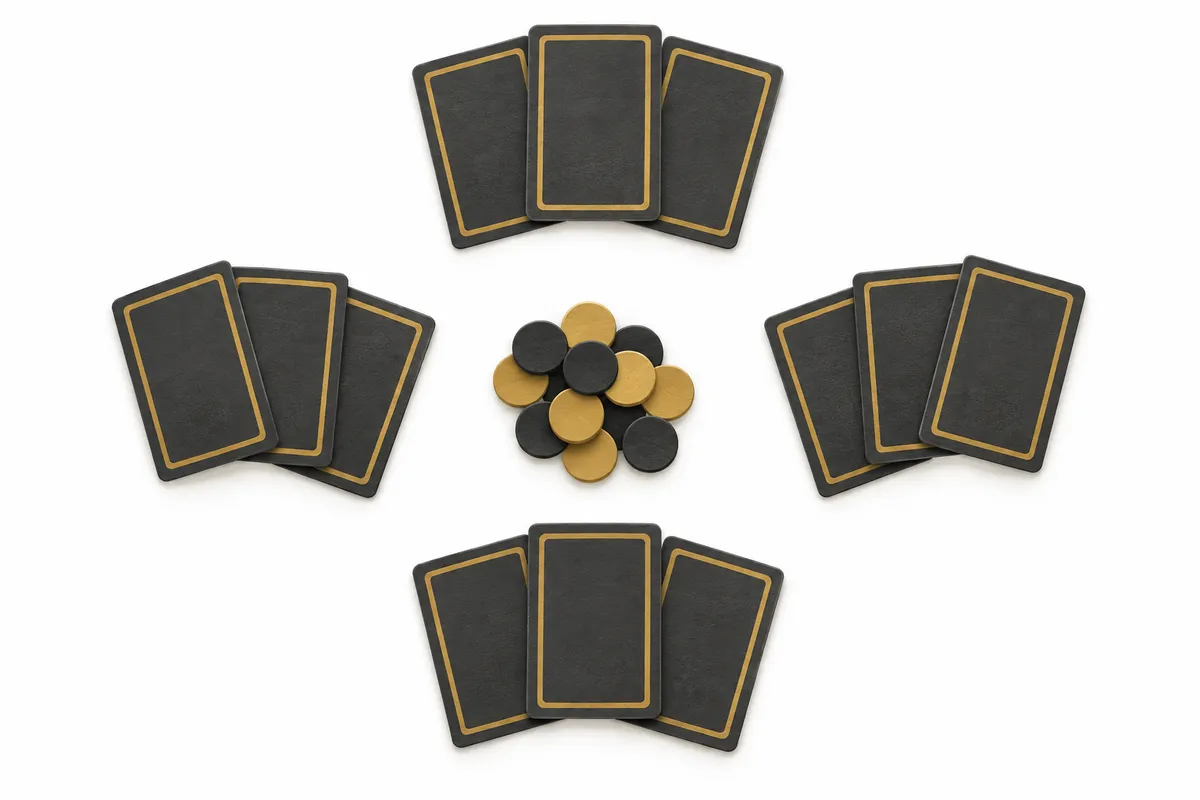
This differs from ordinary blind play. In classic Teen Patti, a player can often choose to look at their cards and continue as a seen player. Potblind can remove that choice for the duration of the hand.
The name does not tell you every rule, however. Contribution amounts, folding options, early endings and tie procedures still need to be checked. The examples below use a defined practice ruleset, not universal app settings.
What Does Potblind Mean?
“Potblind,” sometimes written “Pot Blind,” combines two important features: hidden hands and a pot-related ending condition.
Royal Teenpatti’s published description provides one concrete example. Players receive three cards and cannot inspect them before showdown; reaching the pot limit opens the cards for comparison. This is evidence of that implementation, not a complete rulebook for every app using the name. Royal Teenpatti’s Pot Blind description.
The pot is the shared collection of contributions made during the hand. The pot limit is a threshold applied to that shared total.
It should not be confused with the largest amount one player can contribute on a turn or the amount a player plans to use during a session.
Potblind vs Ordinary Blind Play
| Feature | Ordinary blind play | Potblind format discussed here |
|---|---|---|
| Starting cards | Three private cards | Three private cards |
| Can a player inspect them? | Often allowed before continuing as seen | Not before the designated reveal |
| Seen-player decisions | Usually part of the game | May be unavailable |
| Main ending condition | Folding or an eligible show, depending on rules | Pot threshold triggers comparison |
| Card evaluation | Standard ranking unless a variation changes it | Standard ranking in the examples below |
| Details to confirm | Blind limits, seen costs and show rules | Contributions, folding, threshold and ties |
Playing blind does not improve the cards you received. It changes the information available when you decide whether to continue.
Likewise, remaining blind longer does not make a strong hand more likely. Your private cards have already been dealt.
Understand the Different Limits
Before playing, identify which number on the screen represents which limit.
| Term | Meaning |
|---|---|
| Boot | Opening contribution collected from each player |
| Current stake | Reference amount used to calculate a turn’s contribution |
| Maximum contribution | Largest permitted amount for a particular action |
| Pot limit | Threshold for the shared pot |
| Session allowance | Your personal limit for the whole session |
A table can have a small boot and still accumulate a much larger pot through repeated turns.
For example, a four-player table with a two-token boot begins with eight tokens. That does not mean the maximum commitment is two tokens per player.
Check whether the displayed pot includes the boot and any special fees. Do not assume every interface calculates or labels the total in the same way.
A Complete Practice Ruleset
The following example uses non-redeemable tokens and deliberately simple contribution rules.
Four players receive three cards each from a standard 52-card deck. Printed jokers are removed, and no cards are wild.
Each player contributes a boot of two tokens. On a turn, an active player may contribute two tokens or fold. Cards remain hidden until the pot reaches twenty-four tokens. There are no raises or requested shows in this teaching example.
If everyone except one player folds, that player receives the pot without a card comparison. If several players remain at the threshold, only active hands are compared. Equal best hands split the pot.
These are explicit practice assumptions. An actual app may use different rules, so do not copy these amounts into a live table without checking.
Worked Example 1: Building the Pot
Asha, Ben, Cara and Dev each contribute two tokens before the deal.
| Action | Tokens added | Pot total |
|---|---|---|
| Four boot contributions | 8 | 8 |
| Asha continues | 2 | 10 |
| Ben continues | 2 | 12 |
| Cara continues | 2 | 14 |
| Dev continues | 2 | 16 |
| Asha continues | 2 | 18 |
| Ben continues | 2 | 20 |
| Cara continues | 2 | 22 |
| Dev continues | 2 | 24 |
The threshold is reached after Dev’s second turn. The four active hands are revealed.
Each player contributed six tokens: two for the boot and four across two turns. Together, those contributions total twenty-four.
This accounting exercise helps separate the shared pot from an individual player’s commitment.
Worked Example 2: Comparing the Revealed Hands
Suppose the players reveal these cards:
| Player | Hand | Category |
|---|---|---|
| Asha | 8♣–8♦–K♥ | Pair of eights |
| Ben | 4♠–5♠–6♠ | Pure sequence |
| Cara | A♦–J♦–7♦ | Colour |
| Dev | 9♣–10♥–J♠ | Sequence |
Ben wins under standard Teen Patti category order.
A pure sequence outranks an ordinary sequence, colour and pair. Cara’s ace does not override the category difference, and Dev’s higher sequence cards do not beat a suited run.
Being blind throughout the hand does not change how the cards are ranked once they are revealed.
The example also shows why the amount contributed should not be mistaken for an indication of hand strength. None of the players knew their cards.
Worked Example 3: Folding Before the Limit
Return to the same practice setup, but suppose Cara folds on the first circuit and Dev folds on the second.
Their earlier contributions stay in the pot, but their hands no longer compete at the final comparison.
Asha and Ben continue until the twenty-four-token threshold. Only their active hands are revealed for the result.
Even if Cara later discovers that the folded cards were the strongest, that does not reverse the fold.
Folding is a decision made with the information available at the time. A favourable hidden hand discovered afterward does not prove that the earlier decision was unreasonable.
Whether folding is offered in your actual Potblind mode must be checked before applying this example.
What Happens if a Contribution Crosses the Limit?
A table may reach the threshold exactly or pass it with the final permitted contribution.
Imagine a pot of twenty-two and a proposed contribution of four. The resulting total would be twenty-six, above a twenty-four limit.
The application must define whether it accepts the full contribution, restricts the action, adjusts the final amount or uses another procedure.
Do not assume “pot limit” always means a hard ceiling that can never be exceeded. It may function as a trigger.
For a physical practice game, agree on the treatment beforehand. The fixed two-token example above avoids this ambiguity because every contribution lands on an even total.
Show and Sideshow Rules Need Separate Confirmation
Classic show rules should not automatically be imported into Potblind.
A mode that keeps everyone blind until a threshold may not offer an ordinary requested show. A sideshow can also conflict with the requirement that hands remain unseen.
Look at the controls and rule description. If a comparison option is unavailable, do not assume the app is malfunctioning merely because another Teen Patti mode includes it.
Also check what happens when only two players remain. Some formats may still wait for the pot condition; another implementation may define an earlier ending.
The word “Potblind” alone cannot settle that question.
Exact Ties and Disconnections
Two active hands can have equal strength. Under the teaching rules above, tied best hands share the pot.
An actual application may use another tie procedure. Suits, the final contributor or the order of revealing cards should not be used as tie-breakers unless the rules explicitly say so.
Disconnections are a separate issue. Losing connection may trigger a timeout or another automatic action; it does not guarantee that your hand remains active.
Record the round identifier and displayed result if something appears wrong. Ask support about the actual rule rather than assuming a disconnected player must receive a refund.
Sources
- Royal Teenpatti: one Pot Blind implementation
References above checked on 21 September 2026.