

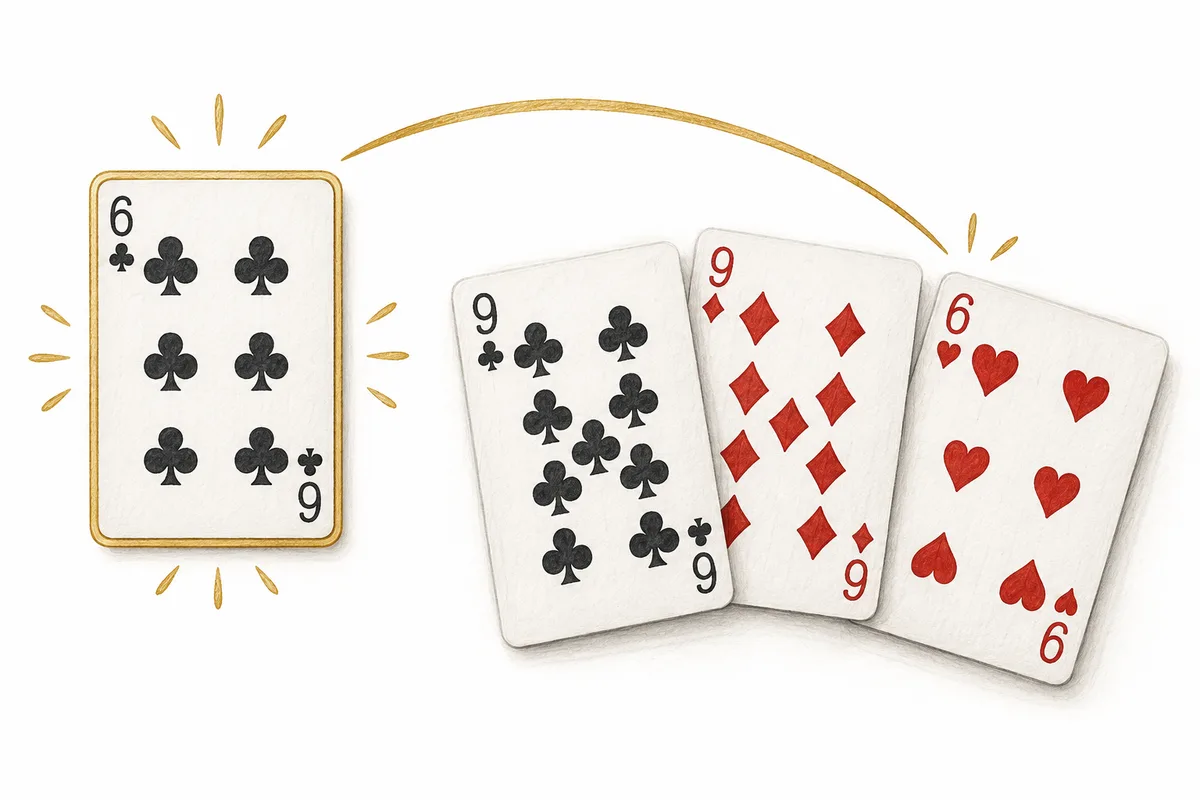
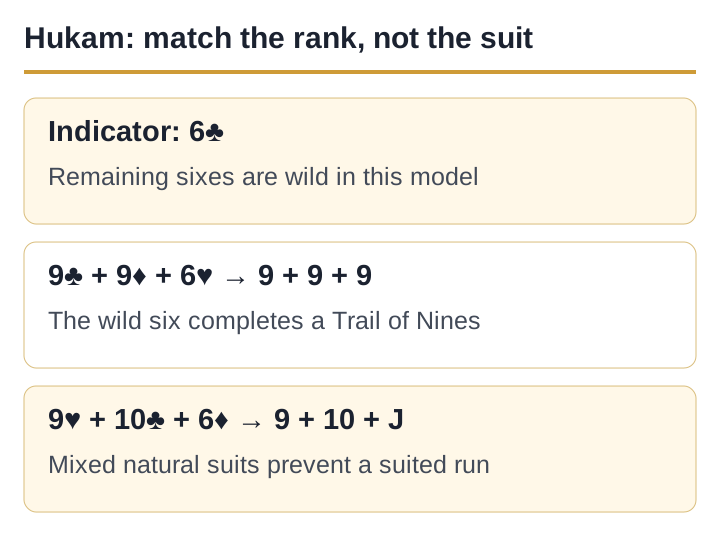
The important detail is what matches the indicator. In a rank-based version, a revealed six makes the other sixes wild, regardless of suit. It does not automatically make every card of the indicator’s suit wild.
The worked hands below use that rank-based format. The examples use unrestricted rank-and-suit substitution and standard high-hand rankings. They are not a claim that every application labelled Hukam applies identical rules.
What Is Hukam in Teen Patti?
In one documented implementation, a card in the centre of the table becomes the Hukam indicator, and cards of the same rank act as jokers. Both Comfun and Gametion describe this rank-based selection in their app listings. Comfun’s Hukam description, Gametion’s Hukam description.
The player still evaluates a three-card hand. The indicator identifies a rule; it is not automatically an extra community card that can be added to everyone’s hand.
A wild card can represent another card when forming a combination. Your natural cards remain fixed.
Before joining a table, confirm whether the designation stays unchanged for the whole hand. A mode that replaces its wild indicator during play requires a different evaluation process.
How Joker Selection Works
For every example below, assume the dealer exposes 6♣ from a standard single deck and keeps it outside the players’ hands.
The remaining sixes—6♦, 6♥ and 6♠—are wild. Other clubs remain ordinary cards.
| Card | Wild under this example? | Reason |
|---|---|---|
| 6♦ | Yes | Matches the indicator’s rank |
| 6♥ | Yes | Matches the indicator’s rank |
| 6♠ | Yes | Matches the indicator’s rank |
| K♣ | No | Matches the suit, but not the rank |
| 5♣ | No | Being near the indicator’s rank is irrelevant |
| A♥ | No | Aces are not automatically wild |
In an app, the indicator may be represented differently. Read whether it is an actual exposed deck card or simply a displayed designation.
That distinction matters when counting available cards. Do not assume that a graphical indicator has been physically removed from the deck unless the rules say so.
Hand Rankings in the Example Ruleset
The wild cards help you build a hand, but the strongest legal category still wins.
| Order | Category | Meaning |
|---|---|---|
| 1 | Trail | Three cards of the same rank |
| 2 | Suited sequence | Three consecutive ranks in one suit |
| 3 | Sequence | Three consecutive ranks in mixed suits |
| 4 | Colour | Three cards of one suit without a sequence |
| 5 | Pair | Two matching ranks |
| 6 | High card | No stronger category |
Some tables call a wild-assisted suited sequence a “pure sequence.” Others distinguish natural and substituted combinations. Check the classification and any natural-hand preference before relying on it.
For these examples, wild-assisted hands receive the category they complete, with no additional preference for natural hands.
Example 1: A Natural Pair Becomes a Trail
Your hand is 9♣–9♦–6♥.
The six of hearts is wild. Assign it the identity 9♥, creating three nines.
The result is a trail of nines.
The two natural nines determine which trail you can form. You cannot turn this hand into three aces, because the joker does not change the other cards.
If an opponent has J♣–J♦–6♠, that opponent can make a trail of jacks and wins under ordinary trail comparison.
Both hands reach the highest category, but their trail ranks differ.
Example 2: A Wild Card Completes a Suited Sequence
Your hand is 9♥–10♥–6♦.
The six of diamonds can represent J♥, producing 9♥–10♥–J♥.
All three effective cards are consecutive hearts, so the hand becomes a suited sequence under the stated rules.
The wild card could also represent 8♥. However, the jack-high completion outranks the ten-high completion under ordinary sequence ordering.
A trail is impossible because the natural nine and ten have different ranks. One wild card cannot make both natural cards match.
Example 3: Mixed Natural Suits Prevent a Suited Run
Your hand is 9♥–10♣–6♦.
The six remains wild and can represent a jack. The completed ranks are nine, ten and jack.
However, the natural nine is a heart and the natural ten is a club. Neither changes suit.
The result is an ordinary sequence rather than a suited sequence.
This comparison shows why it is useful to separate natural cards before assigning the joker. Their fixed suits determine which categories remain possible.
Example 4: A Wide Gap Leaves a Colour
Your hand is 2♠–9♠–6♥.
The natural cards share a suit, but their ranks cannot fit into one three-card sequence.
Use the wild card as A♠. The completed hand is A♠–9♠–2♠, an ace-high colour under the example’s ace-high convention.
A trail cannot be formed because the two natural ranks differ. A sequence cannot be formed because the gap is too large.
The colour is therefore the strongest available category.
Example 5: A Wild Card Produces a Pair
Your hand is 3♣–Q♦–6♠.
The natural three and queen have different suits and cannot belong to a three-card sequence.
Use the wild six as another queen. This creates a pair of queens with a three kicker.
Representing another three would create a lower pair. Representing an ace would leave only a high-card hand.
This is a useful reminder that a joker’s flexibility does not guarantee a trail or sequence. The natural cards limit the result.
Example 6: Two Wild Cards Follow the Natural Rank
Your hand is K♣–6♦–6♥.
Both sixes are wild. They can represent K♦ and K♥, completing a trail of kings.
The natural king must remain part of the hand. Assigning the wild cards as aces would produce only a pair of aces with a king, which loses to a trail.
Always compare categories before deciding which substitution looks strongest.
Under these rules, two wild cards and one natural card can make a trail of that natural rank.
Example 7: All Three Cards Are Wild
Your hand is 6♦–6♥–6♠.
All three cards are wild because 6♣ is the exposed indicator. Under unrestricted substitution, they can represent three aces.
However, confirm whether your table has a special rule for all-wild hands. Also check how equal completed hands are settled.
A maximum-ranked combination does not automatically establish who wins an exact tie. The show procedure remains relevant.
Quick Review of the Worked Hands
| Dealt hand | Best illustrated result |
|---|---|
| 9♣–9♦–6♥ | Trail of nines |
| 9♥–10♥–6♦ | Jack-high suited sequence |
| 9♥–10♣–6♦ | Jack-high ordinary sequence |
| 2♠–9♠–6♥ | Ace-high colour |
| 3♣–Q♦–6♠ | Pair of queens |
| K♣–6♦–6♥ | Trail of kings |
| 6♦–6♥–6♠ | Trail of aces |
These are effective hand interpretations. No extra cards are dealt, and the natural cards are not physically replaced.
Hukam vs Joker vs AK47
Hukam and Joker can overlap in their mechanics. One publisher may call a revealed-rank format Hukam, while another uses Joker for a similar rule.
AK47 usually designates aces, kings, fours and sevens as wild ranks. That is a different selection method from revealing one rank for the deal.
A revolving-joker mode can change the designation after particular actions. Do not assume Hukam does this simply because both modes use indicators.
The mode description matters more than the name alone.
Rules to Check Before Playing
Confirm whether matching rank, matching suit or another condition makes a card wild. Then check whether wild cards may change both rank and suit.
Read the sequence order involving aces. A–2–3 and A–K–Q are not ordered identically at every table.
Also establish whether natural hands beat equivalent wild-assisted hands, how shows are requested and what happens when completed hands tie.
These details cannot be resolved by counting jokers alone.
Frequently Asked Questions
Does a club indicator make every club wild?
Not in the rank-based version explained here. With 6♣ as the indicator, the remaining sixes are wild.
Can I use the indicator as a fourth card?
Not under this example’s rules. It identifies the wild rank and remains outside your hand.
Can one joker fill two positions?
No. Each wild card represents one card in the completed three-card hand.
Does a joker guarantee a strong hand?
No. Its value depends on the natural cards and permitted substitutions.
How should beginners practise?
Use non-redeemable tokens and explain each substitution aloud after a practice hand ends. Keep a session limit and avoid treating wild-card games as a source of dependable income.
Sources
- Gametion: Hukam rank-selection description
- Comfun: centre-card and matching-rank description
Publisher pages checked: 8 September 2026.