

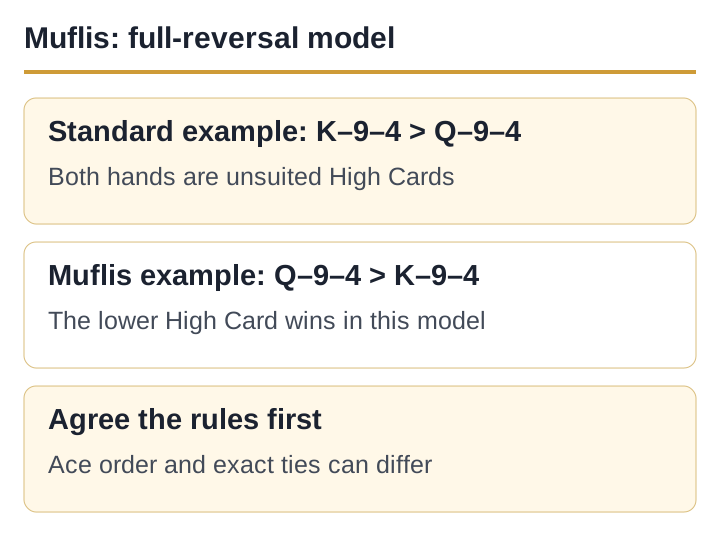
What changes—and what usually stays the same
Muflis is commonly described as low-hand or reverse Teen Patti. Players still receive three cards and may still play blind or seen, make a chaal, pack, request a side show where allowed, and reach a show. The comparison at the end is what changes.
This guide uses a full-reversal model: the weakest standard category becomes the best Muflis category, and lower cards win comparisons inside a category. That is a useful baseline, not a universal house rule.
“Lowest hand wins” does not by itself define whether Ace is high or low, whether A-2-3 is treated specially, or how equal hands are settled.
Muflis hand rankings in the full-reversal model
- Trail / Trio
- Pure Sequence
- Sequence
- Colour
- Pair
- High Card
- High Card
- Pair
- Colour
- Sequence
- Pure Sequence
- Trail / Trio
The cards have not changed category. A Pair is still a Pair; it simply loses to a High Card when the hierarchy is fully reversed. This distinction prevents the common mistake of calling a low pair the best possible Muflis hand.
How High Card and Pair hands are compared
High Card: compare downward from the highest card
Eight-high
Explore other Teen Patti variations
Ten-high
Eight is lower than ten, so Player A wins under the full-reversal model. If the highest cards match, compare the second-highest card, then the third.
9-6-3
9-7-2
Both hands are nine-high; six is lower than seven, so the left hand wins.
Pair: lower pair, then lower kicker
A pair of fours normally beats a pair of sevens. If both players show the same pair rank, compare the unmatched card: 6-6-5 beats 6-6-9 in the same reverse-comparison model.
K-8-3 High Card still beats 2-2-4 Pair when categories are fully reversed. Do not compare the printed twos before identifying each hand category.
Sequences, Colours and Trails
When two hands belong to the same category, the common reverse rule favours the lower completed hand. A 5-4-3 Sequence therefore beats a 9-8-7 Sequence; a 3-3-3 Trail beats a 9-9-9 Trail when only two Trails are compared.
Across categories, however, a Trail remains the least desirable Muflis category in the full-reversal ladder. Even 2-2-2 normally loses to a Pure Sequence, Sequence, Colour, Pair or High Card.
For two Colours, compare the highest card, then the next. Suits normally do not create an extra rank. For Sequences, check the table’s stated order before applying a reversal: A-2-3 and A-K-Q are a known house-rule boundary.
Ace and exact-tie rules are not universal
| Rule question | Why it changes the result | What to confirm |
|---|---|---|
| Ace high or low? | A-6-3 may be ace-high or lower than 8-5-2. | The value of Ace in High Card comparisons. |
| A-2-3 position? | Its Sequence rank can move from one end of the ladder to another. | The displayed sequence order. |
| Equal cards, different suits? | Traditional comparisons usually do not rank suits. | Split result or show-request rule. |
| Partial or full reversal? | Some tables describe only “lowest hand” without a complete category chart. | The actual ranking panel, not the room name. |
If 8-5-2 appears in different suits for both players, the card values are equal. A table may split the result or apply a rule to the player who requested the show; do not invent a suit hierarchy unless the table publishes one.
Six checks before playing Muflis
- Find the ranking panelConfirm that all six standard categories are reversed.
- Check the AceRecord whether it remains high, becomes low, or changes only in a sequence.
- Check A-2-3Do not import the order from another app or home game.
- Read the tie ruleLook for split-pot or show-request wording.
- Separate cards from stakesBlind and seen contribution rules can vary even when hand order is clear.
- Use free-play firstA reverse ladder does not remove chance or make an outcome predictable.
Sources and rule scope
- Octro Teen Patti variations — an operator-published example stating that Muflis keeps normal play but awards the weaker hand; accessed 3 September 2026.
- Teen Patti hand-ranking baseline — the six conventional categories reversed in the model above.
- Teen Patti variations overview — explains why a mode name is not enough to settle table-specific details.
Scope: common full-reversal Muflis convention. This page does not claim that every Teen Patti Gold room currently uses the same implementation.
Published and source-checked: 4 September 2026. Live app, policy and table rules can change; material changes require a fresh review.