


This guide uses a rank-joker model: one exposed indicator sets the wild rank, and wild cards may represent a chosen rank and suit. Octro documents this kind of Joker variant. Other modes use different selection rules; do not apply these examples unchanged to every game carrying a joker label.
Identify the joker before comparing hands
Start with a regular 52-card deck without printed jokers. For the model used here, deal three cards per player, then expose one card from the remaining deck as the indicator. If the indicator is 6♣, set it aside: the remaining sixes, 6♦, 6♥ and 6♠, are wild.
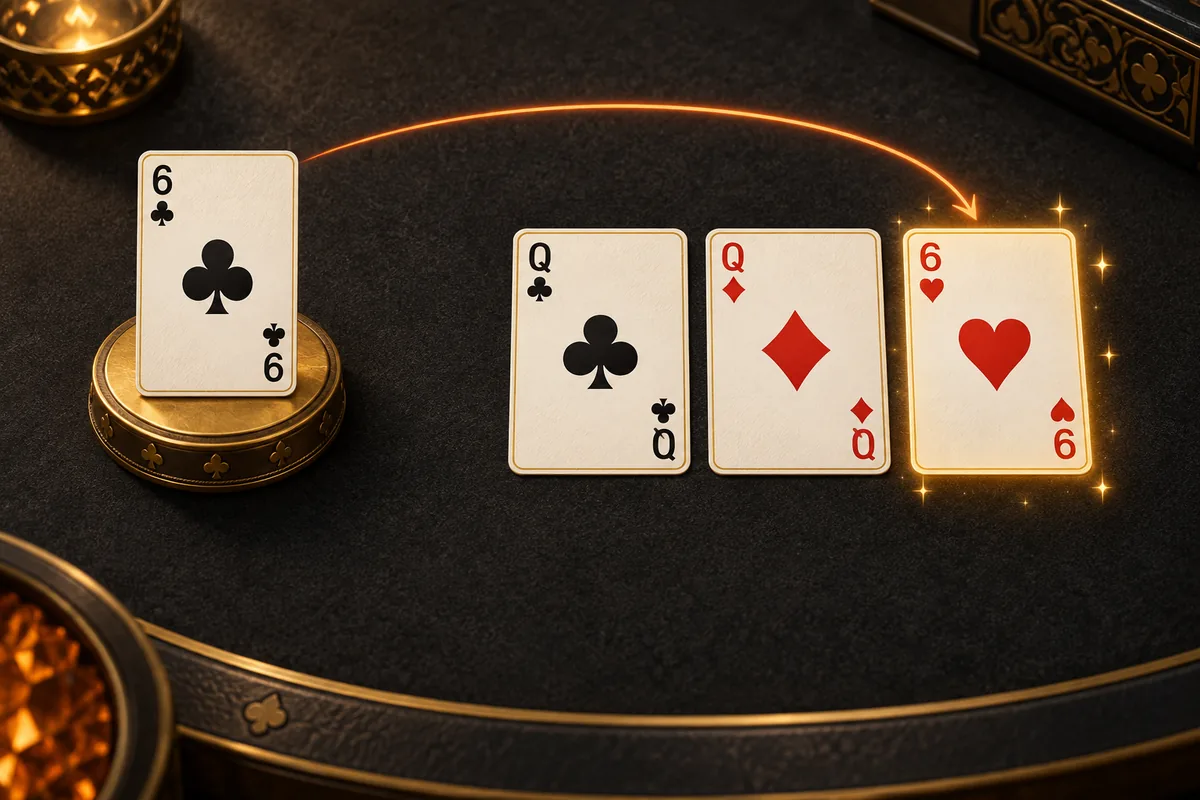
The indicator is not a fourth card in anybody's hand. A wild card in your hand can be assigned a useful value when that hand is evaluated; the other, natural cards keep their actual rank and suit. You still form a three-card hand.
At a physical table, agree that a substitution must describe a possible three-card hand: it cannot duplicate an identical card already represented in that hand. A pair or trail is fine because its cards have different suits. Do not assume this extra detail or any “natural beats wild” tiebreaker is identical across apps; read the selected mode's help.
Keep these joker systems separate
| Mode or setup | What selects the wild cards? | What to check before playing |
|---|---|---|
| Rank joker used here | One exposed indicator's rank | Whether substitution can change both rank and suit |
| AK47 | A, K, 4 and 7 are designated ranks | All suits and the mode's tie rules |
| Lowest-card joker | A low rank in the player's own hand | How an ace and tied lowest cards are handled |
| Revolving joker | An indicator can change during play | Exactly which event changes it |
| Printed-joker house game | Extra joker cards are added to the deck | Deck size and permitted substitutions |
These are different rule systems, not interchangeable names. For the specific four-rank version, read AK47 wild cards. For a related indicator-based discussion, see Hukam rules. Neither should be treated as proof that a Gold table offers identical settings.
Six worked hands with a six as joker
Each row below is a separate deal, with 6♣ set aside as the indicator. The examples use the ordinary category order: trail beats pure sequence, then sequence, colour, pair and high card. No special natural-hand bonus is assumed.
| Cards dealt | Useful substitution | Best category and why |
|---|---|---|
| Q♣ Q♦ 6♥ | 6♥ represents Q♠ | Trail: three queens |
| 9♥ 10♥ 6♠ | 6♠ represents J♥ | Pure sequence: 9–10–J, all hearts |
| 9♥ 10♣ 6♦ | 6♦ represents J♠ | Sequence: natural cards have different suits |
| A♠ 6♦ 6♥ | Wilds represent A♥ and A♣ | Trail: three aces |
| 2♣ 8♣ 6♠ | 6♠ represents A♣ | Colour: an ace-high club hand |
| 2♣ 8♦ 6♥ | 6♥ represents 8♠ | Pair of eights with a two kicker |
The fifth row is a useful trap. Turning the wild card into another eight makes a pair, but a colour ranks above a pair. The sixth row cannot make a colour because its two natural cards have different suits. It also cannot make a sequence because 2 and 8 are too far apart. A pair of eights is therefore better than a pair of twos.
In the second row, a jack makes a higher pure sequence than an eight. Finding a legal hand is only the first step; choose the strongest legal interpretation available.
Compare the best hand, not the number of wilds
Suppose one player has Q♣ Q♦ 6♥ and another has J♣ 6♦ 6♠, with 6♣ as indicator. The first player forms three queens using one wild. The second forms three jacks using two. Three queens win, even though that player has fewer wild cards.
The same principle works across categories: a pure sequence beats a colour regardless of whether the colour used more wilds. Count wilds to explore the possible hands; do not use their count as a replacement for the ranking system.
For a repeatable method, mark the wilds, leave natural cards unchanged, test the strongest category you can form and then compare ranks within that category. Only after the evaluated hands are equal should you consult the mode's tie and pot rules.
Common mistakes that change the result
Changing a natural card's suit. With 9♥ 10♣ and one joker, you cannot turn the natural ten of clubs into a heart. The wild replaces only itself.
Using the indicator as an extra card. A three-card deal remains three cards. The face-up indicator identifies a rank; it does not join the player's hand.
Stopping at the first substitution. A wild plus two suited natural cards might make a colour or a pure sequence. A wild plus a natural pair makes a trail. Evaluate the strongest option instead of choosing the first one noticed.
Assuming every ace sequence follows one order. Agree whether AKQ or A23 is higher. This matters when comparing sequences, including ones completed by a wild card. KA2 should not silently become valid just because a joker is present.
Adding an unstated natural-hand preference. Some tables may treat equal natural and wild-made hands differently. Do not invent that rule after the reveal. Check the mode or agree in advance.
A short practice exercise
With 6♣ still the indicator, compare these separate hands: K♥ Q♥ 6♦ and 10♣ 10♦ 6♠. The first can become A♥ K♥ Q♥, a pure sequence. The second can become three tens, a trail. The trail wins under the category order used here, even though the pure sequence contains an ace.
Now remove the wild from the first hand and replace it with J♣. K♥ Q♥ J♣ is an ordinary sequence, not a pure sequence: one card is a different suit. This is why checking suits must come after identifying which cards are actually wild.
Our classic hand comparison tool evaluates ordinary hands without jokers. Do not enter a six there and expect it to act as a wild card. Use these worked substitutions for the joker exercises.
Frequently asked questions
Does a printed joker have to be in the deck?
No. In the rank-joker setup here, ordinary cards become wild. A game that adds printed jokers is a separate house variant and changes the deck.
Can a joker make a trail?
Yes, under this substitution model. A natural pair plus one wild can form a trail; one natural card plus two wilds can also form a trail of that natural rank.
Do three wild cards automatically win the pot?
They allow a very strong interpretation, but an automatic win or a special “three jokers” category needs an explicit rule. This guide does not add one. Equal evaluated hands still require a tie rule.
Is an equal hand always split?
No. Hand equality and pot settlement are separate questions. Read the tie rules guide and check the specific mode's show conditions.
Sources
Rule and product references checked on 24 September 2026.