


This guide sets up a small, no-cash practice table. Its suggested limits are house rules for learning, not settings claimed to exist in Teen Patti Gold. If you meant playing the Gold app without internet, a physical-card guide cannot confirm that feature; check the current app's requirements separately.
What you need before dealing
Use one complete 52-card deck with the printed jokers removed, a flat playing surface and identical counters. Three to six players is a manageable first group. Give each person 20 counters, put the remaining supply aside and agree that counters cannot be bought, redeemed or exchanged for prizes.
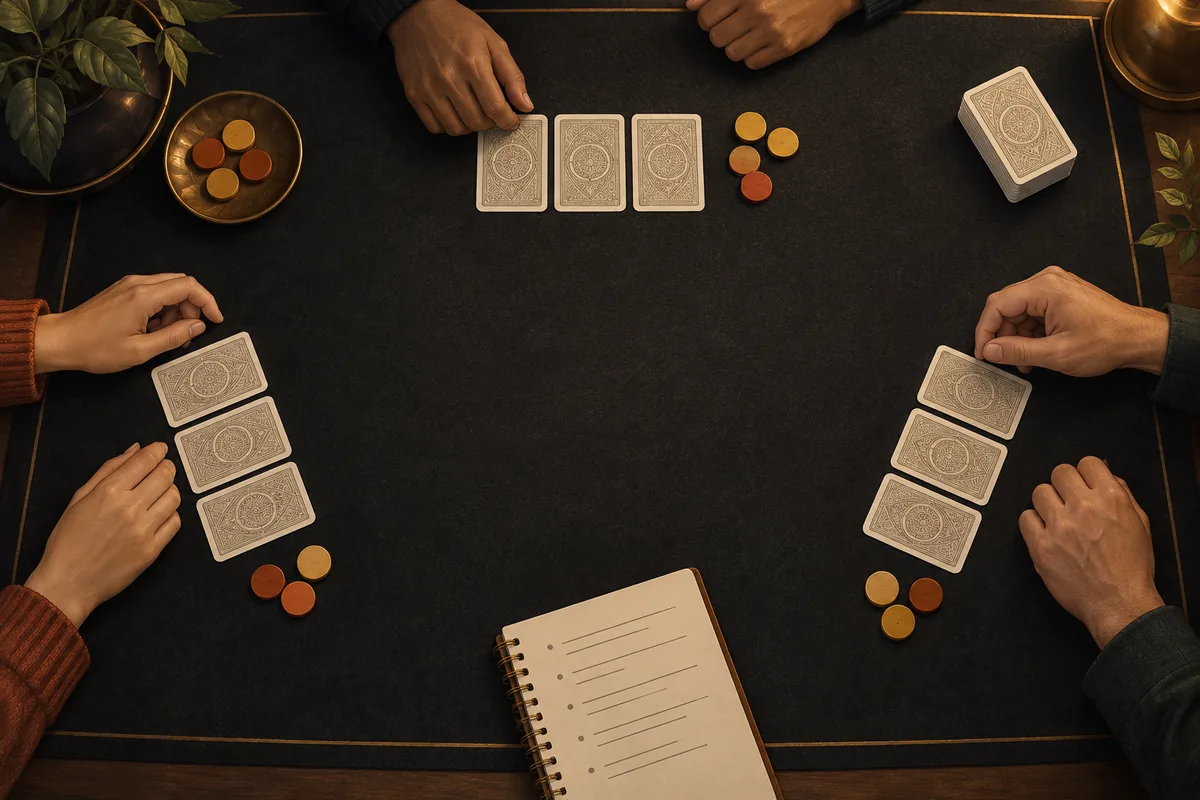
| Item | Set it up this way | What it prevents |
|---|---|---|
| Deck | Count 52 cards; remove jokers | Unexpected wild cards or missing ranks |
| Counters | 20 per player; boot of 1 each round | Confusion about the opening pot |
| Seat order | Play clockwise; dealer moves one seat each round | Arguments over whose turn comes next |
| Time | Stop after 20 minutes or six rounds | An open-ended session |
| Rule sheet | Everyone agrees before the first deal | Changing a rule after seeing a hand |
Do not mix two decks to accommodate extra people: duplicate cards change which equal hands are possible. Split a large group into separate tables instead. Someone who already knows the game can deal the first demonstration with all cards face up; restart with a fresh shuffle for the first actual round.
Agree on five rules, then write them down
For this practice session, use the usual category order: trail, pure sequence, sequence, colour, pair, high card. Choose AKQ above A23, with A23 above KQJ, and do not allow KA2 as a sequence. Other tables can use a different ace order, so the agreement matters more than assuming everyone learned the same version.
Also record whether suits break ties, how blind and seen stakes work, what happens at the counter limit and what happens to an exactly tied pot. Our suggested learning rules are: no suit tiebreaker, no sideshow, no borrowing and equal division of an exact tie. These are deliberate simplifications. They are not universal app rules.
Download the offline table worksheet. Print it or copy it onto paper, fill in the choices, and keep it visible during play. For fuller hand examples, use the hand-ranking chart.
Deal and run the first round
- Each player puts one counter into the centre as the boot. With four players, the opening pot is four counters.
- The dealer shuffles, offers a cut and deals three face-down cards to each person, one card at a time clockwise. Leave the unused deck face down.
- Start with the seat immediately after the dealer. A player who has not looked is blind; once they inspect their cards, they are seen for the rest of that round.
- For the first learning round, use fixed turns: a blind player adds one counter or packs; a seen player adds two or packs. Do not add raises yet. This is a practice rule, not a complete standard betting system.
- Continue clockwise, skipping players who packed. If only one player remains, they take the pot without needing to reveal their cards.
- When two remain, end with a free reveal on the next turn. Also end with a reveal among remaining players after two circuits, or before anyone would have to add counters they do not have. These limits keep this particular practice session simple.
Keep each player's cards separate from the unused deck. Packed cards go face down into a discard area and cannot re-enter the round. If a card is exposed during the deal, or someone receives the wrong number, return that round's counters and redeal. Agree on that misdeal rule before it is needed.
A four-player example you can reproduce
Asha, Bilal, Charu and Dev each post one counter: pot 4. Asha stays blind and adds 1: pot 5. Bilal looks, becomes seen and adds 2: pot 7. Charu packs without adding more. Dev looks and adds 2: pot 9.
On the next circuit, Asha looks and packs. Bilal and Dev are now the final two, so this learning table reveals without another payment. Bilal has Q♣ Q♦ 5♠; Dev has J♥ J♠ A♦. Bilal wins the nine-counter pot because a pair of queens beats a pair of jacks. Dev's ace does not overturn the higher pair.
The counters balance: 80 were on the table initially and 80 remain after the pot is awarded. Counting that total is a quick way to spot an accidental extra payment. A different stake system would change the pot size, but not the comparison of these two hands.
Handle equal hands and disagreements calmly
Two hands in the same category are not necessarily tied. With equal pairs, compare the third card; with colours, compare the highest, then middle, then lowest card. An exact tie means all relevant ranks are equal under the agreed rules.
For this no-cash table, split an exactly tied pot equally among the tied highest hands. Leave any indivisible counter in the centre as part of the next round's opening pot; if the session has ended, return it to the spare supply. This is a house-rule choice, not a claim that every app splits pots. See the tie-rule examples before using an app's show or sideshow rules.
When a rule is missing, pause and agree on it for future rounds. Avoid inventing a favourable interpretation after cards are revealed. If the current round cannot be resolved fairly, return each player's contribution and redeal.
Move beyond the practice table
Once everyone can identify hands and track turns, learn a fuller blind/seen structure using the step-by-step play guide. Change only one feature at a time: first the stake system, then show requests, then sideshow if wanted. Write the new rule down before dealing.
Keep joker variants for a separate session. A wild-card game changes how hands are formed, so it needs an additional agreement about substitutions. Our joker guide includes examples you can lay out with a deck.
Frequently asked questions
Is offline Teen Patti the same as an offline APK?
No. Here, offline means people playing physical cards in the same room. A download labelled “offline” does not establish that it is an official app or that all its features work without a connection.
Can two people practise?
Yes, two people can deal and compare hands, but the multi-player decisions are reduced. Three or more is more useful for learning turn order and packing. You can practise hand comparison alone by dealing two separate hands.
Do we need money or chips from an app?
No. Paper tokens or counters are enough. The setup here deliberately gives them no purchase price, cash value or prizes.
Should the dealer win an exact tie?
Only if that was an explicit house rule. This guide uses equal division instead. The dealer's seat and a card's suit do not silently become tiebreakers.
Sources
Rule and product references checked on 24 September 2026.