

Guide updated:
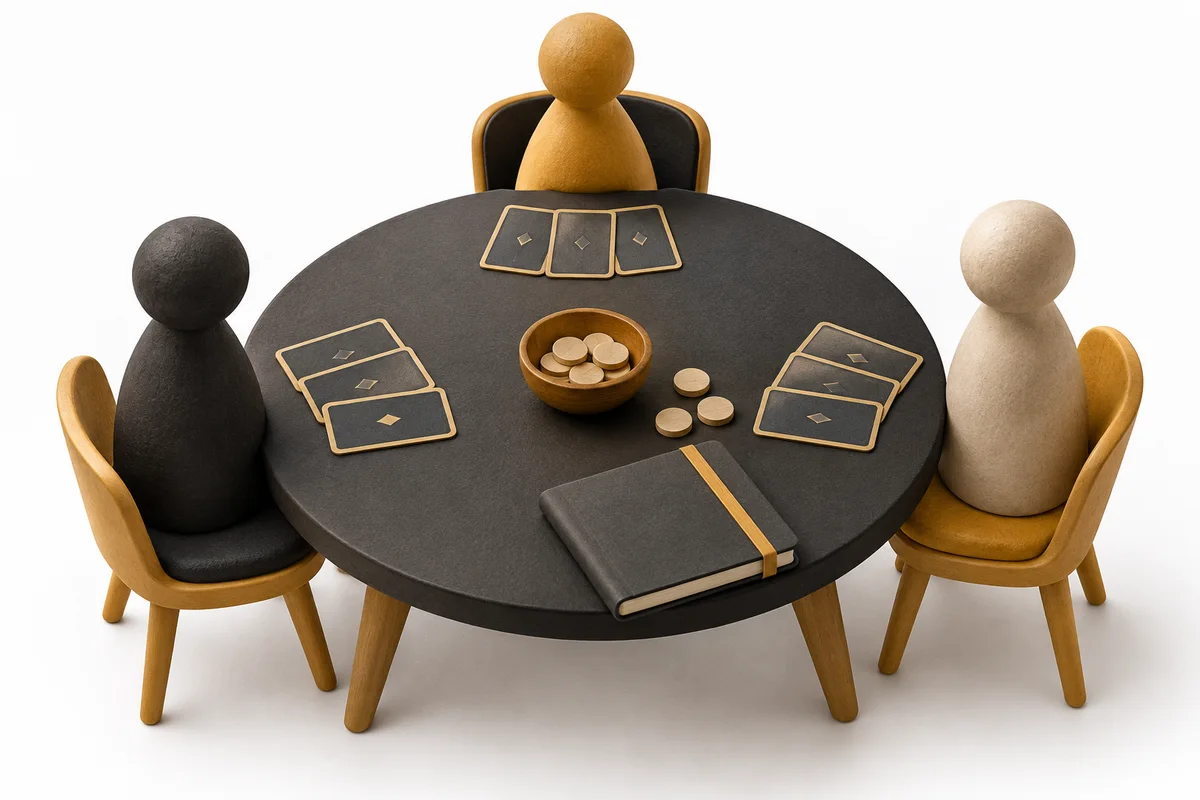
Here, “master Teen Patti” means learning the card game. It does not refer to an application named Teen Patti Master, and the examples do not claim to reproduce a particular Teen Patti Gold screen. They use classic three-card play and explicitly stated teaching rules.
For the basic turn order, see how to play Teen Patti. You can complete every exercise with a standard deck and non-cash counters. No purchase, deposit, or large chip balance is needed to understand the decisions.
Start by Agreeing the Table Rules
Before dealing, identify the variation, boot, contribution limits, blind restrictions, ace-sequence order, and final-show procedure. If friends use different rules, settle the disagreement before anyone sees a hand.
The boot is each player’s starting contribution to the pot. It is not the same thing as a maximum bet or maximum pot. A table can have a small opening contribution while allowing the cost of later decisions to rise.
For a first lesson, simplify rather than improvising halfway through. Use no jokers, equal starting counters, fixed contributions, and a clearly stated stopping condition. These are teaching choices, not universal rules imposed on every table.
Read Three Cards in a Consistent Order
First check for matching ranks. Three matching ranks make a trail; two make a pair unless a special variant changes the interpretation. Next check whether the ranks are consecutive, and whether all suits match. Finally, consider colour or high card if no stronger category applies.
The complete ordinary order is trail, pure sequence, sequence, colour, pair, then high card. Always award the strongest applicable category. The hand 7♥ 8♥ 9♥ is a pure sequence, not merely a colour.
For a same-category comparison, use the correct detail. Compare pair ranks before kickers; compare colours and high cards from highest rank downward; apply the table’s ace convention to ace-containing sequences.
Three Quick Reading Tests
| Comparison | Correct explanation |
|---|---|
| 4♣ 4♦ 4♥ against J♠ Q♠ K♠ | Trail beats pure sequence |
| 9♣ 9♦ 2♥ against 8♣ 8♦ A♠ | Higher pair wins before the kicker matters |
| K♥ J♥ 6♥ against K♣ J♣ 5♣ | Both colours; six beats five after two equal ranks |
Say the explanation aloud. If your reason is only “that card looks bigger,” return to the category check. A repeatable comparison method is more reliable than an instinctive impression.
Blind and Seen Describe Information
A blind player has not looked at the cards. A seen player has. Looking does not improve or replace the cards, but it commonly changes the contribution required to continue.
For example, an agreed practice table might require one counter from a blind player and two from a seen player at the current level. That relationship is a teaching example; real table rules may permit raises, limit blind rounds, or define the current stake differently.
Once you have seen your hand, do not pretend you are still blind to pay less. In a home game, announce the change clearly. In an app, read the next action amount rather than assuming it has stayed the same.
Blind play is not a method for making stronger cards appear. Its distinguishing feature is that you make decisions without knowing your own hand, which can make it harder—not easier—to explain those decisions while learning.
A Complete Practice Round with Pot Arithmetic
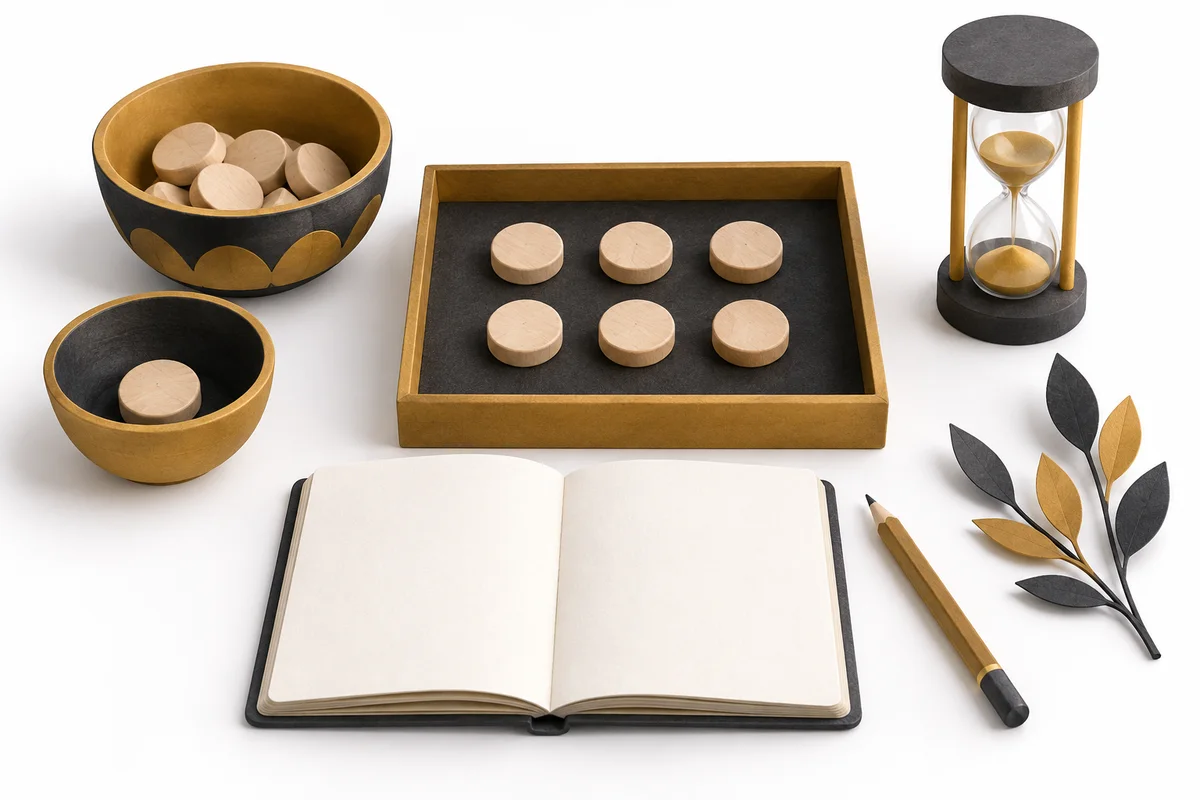
Use three players: Asha, Ben, and Chitra. Each starts with twenty counters and contributes a boot of one. Agree in advance that this training round allows one blind contribution of one, one seen contribution of two, then a free face-up comparison if two players remain. The free comparison is a simplified lesson rule, not the standard paid-show procedure.
| Stage | Asha’s stack | Ben’s stack | Chitra’s stack | Pot |
|---|---|---|---|---|
| Before the boot | 20 | 20 | 20 | 0 |
| All pay one | 19 | 19 | 19 | 3 |
| Asha continues blind for one | 18 | 19 | 19 | 4 |
| Ben looks and continues for two | 18 | 17 | 19 | 6 |
| Chitra packs | 18 | 17 | 19 | 6 |
Asha reveals 7♣ 7♦ Q♥. Ben reveals 8♣ 8♦ 3♠. Ben has the higher pair, so he receives the six-counter pot under the agreed exercise rules. His final stack becomes twenty-three; Asha has eighteen and Chitra nineteen.
The total remains sixty: 23 + 18 + 19. Ben received six counters, but his net gain was three because he had contributed three. Chitra cannot reclaim the boot after folding, and Asha’s queen does not outrank Ben’s pair of eights.
This single exercise checks hand reading, blind/seen contributions, folding, and the difference between a pot award and net gain. Repeat it with different hands before adding more complicated raises or show fees.
Know What Packing Does—and Does Not—Mean
Packing ends your participation in the current round. It gives up the chance to win that pot, including the counters already contributed. It does not mean that you must leave the whole session or prove that your hand was objectively hopeless.
A beginner mistake is continuing solely because “I have already put chips in.” Those past contributions cannot be recovered by wishing the next decision were cheaper. Evaluate the next required contribution separately and respect the practice limit agreed at the start.
Equally, seeing that a folded hand would have won does not prove the fold was irrational. You made the decision without knowing every opponent’s cards. Review the information available at the time, not only the later reveal.
Show, Sideshow, and Automatic Endings
A final show compares the remaining eligible hands under the table’s conditions. A sideshow is a separate comparison during an ongoing round, usually restricted to eligible seen players. Its availability, acceptance rules, and equal-hand outcome require their own instructions.
Do not treat a sideshow button as an automatic free preview of an opponent. An accepted comparison can eliminate a player, and the whole pot is not necessarily awarded at that moment.
Exact rank ties also need a settlement policy. Some final-show rules make the requester lose on equality. An automatic showdown has no obvious requester, so it needs an explicit procedure rather than an improvised application of that rule. Check these details before they decide a disputed result.
Replace Common Mistakes with Specific Checks
| Beginner mistake | Better check |
|---|---|
| Comparing only the highest card | Classify the hand first |
| Calling three red cards a colour | Check that all three suits match |
| Treating K-A-2 as a sequence | Check consecutive ranks without wraparound |
| Assuming the next action costs the same | Read the current contribution before acting |
| Treating a big bet as proof of a trail | Separate an action from confirmed card information |
| Trying to recover losses in one round | Keep the original session limit |
These checks reduce preventable errors without pretending to predict outcomes. An opponent’s confidence, a run of losses, or a familiar animation does not reveal the next deal.
Review One Decision, Not Just the Final Result
After a practice round, write down the mode, your hand category, whether you were blind or seen, the next action cost, and why you continued or packed. Then compare that explanation with the actual rules.
If you misread a pair, work on classification. If you paid the wrong amount after looking, work on blind/seen transitions. If the cards were equal but the result surprised you, inspect the settlement rule. Each error calls for a different lesson.
Stop after a planned period rather than after reaching a target balance. Teen Patti can be learned without real-money stakes, and familiarity with its rules does not guarantee winning or validate an app’s safety. The useful sign of progress is that you can explain the round accurately, including what remained unknown when you made your decision.
Ready to organise a table with friends? Use the offline Teen Patti setup and house-rule worksheet.
Sources
Rule and product references checked on 21 September 2026.