

Guide updated:
The phrase “3 Patti sequence list” often means the whole ranking chart. In the rules themselves, however, a sequence is a specific combination of three consecutive ranks. Knowing the distinction prevents confusion between “the ranking list” and “a run of cards.”
Use the hand-ranking reference for a quick lookup; use the examples below to practise classification. Before applying it to an app table, check the selected variation, the treatment of ace runs, and the rule for equal hands. A chart for classic play should not be used unchanged for Muflis or a wild-card game.
The 12 Teen Patti sequences: complete list
A-2-3 and A-K-Q need a specific rule because different tables rank them differently. Some put A-2-3 first and A-K-Q second. Others put A-K-Q first, with A-2-3 second or low according to the implementation. Do not assume the table follows the ordering you learned elsewhere.
The chart below deliberately uses the A-2-3-high convention. It is an example of a complete ordering, not a claim about every Teen Patti Gold mode or every home game.
| Position under this convention | Rank pattern |
|---|---|
| 1 | A-2-3 |
| 2 | A-K-Q |
| 3 | K-Q-J |
| 4 | Q-J-10 |
| 5 | J-10-9 |
| 6 | 10-9-8 |
| 7 | 9-8-7 |
| 8 | 8-7-6 |
| 9 | 7-6-5 |
| 10 | 6-5-4 |
| 11 | 5-4-3 |
| 12 | 4-3-2 |
Use this rank order separately within pure sequences and ordinary sequences. A lower pure sequence still beats a higher ordinary sequence because the categories differ. Also, K-A-2 is not a normal sequence: an ace at the top or bottom does not create a circular rank order.
Another common order: if your table ranks A-K-Q first and A-2-3 second, swap the first two rows; the remaining rows stay the same. This list is for classic play without jokers. A table that treats A-2-3 as the lowest run needs that separate ordering.
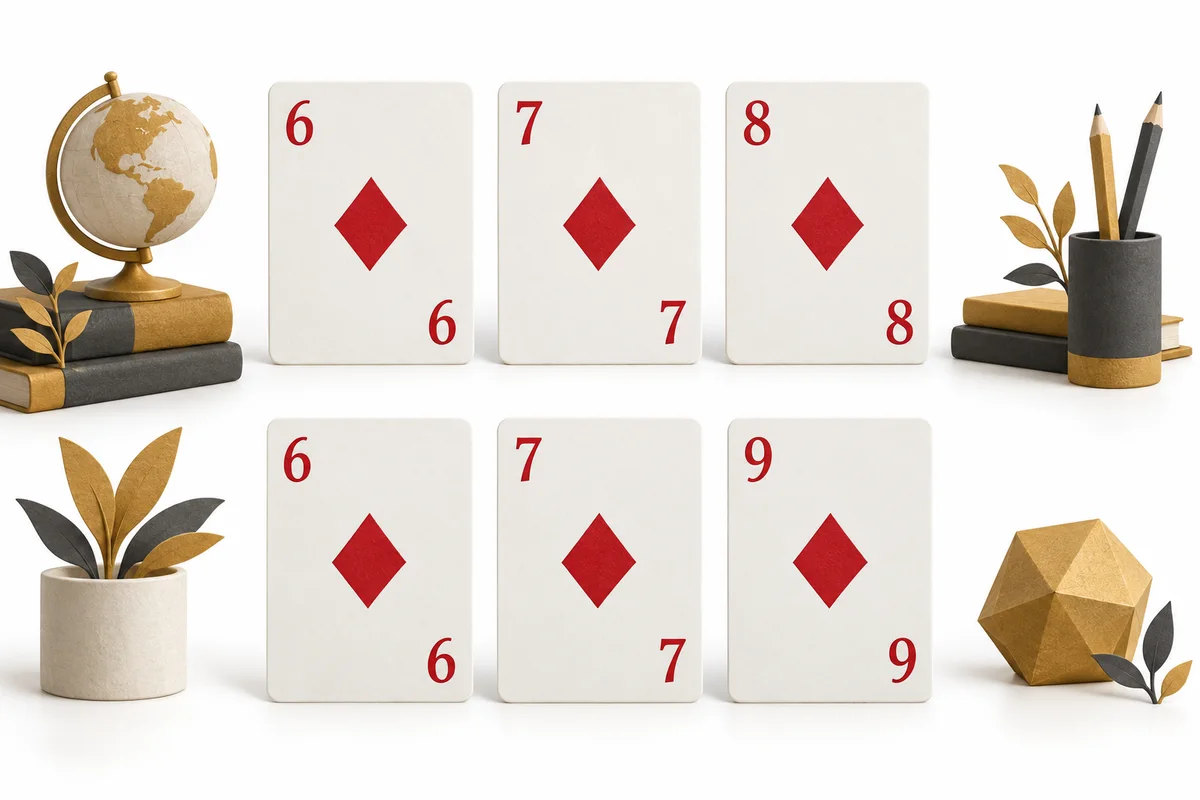
Pure Sequence: Check Suit and Continuity
A pure sequence satisfies two tests. Its ranks must be consecutive, and its suits must match. The hand 6♦ 7♦ 8♦ passes both. The hand 6♦ 7♦ 9♦ fails continuity; it is a colour instead.
A hand should receive its strongest matching category. The pure sequence 6♦ 7♦ 8♦ also has three diamonds, but calling it only a colour would underestimate its rank.
For non-ace runs, compare the upper end of the run: 9♣ 10♣ J♣ beats 7♥ 8♥ 9♥. The club suit has no special superiority over hearts. What matters is the higher run within the same category.
Sequence: Mixed Suits Still Form a Run
A sequence contains consecutive ranks without all three suits matching. The hand 5♠ 6♠ 7♦ qualifies even though two cards are spades. Mixed suits can mean two suits or three; it does not require every card to have a different suit.
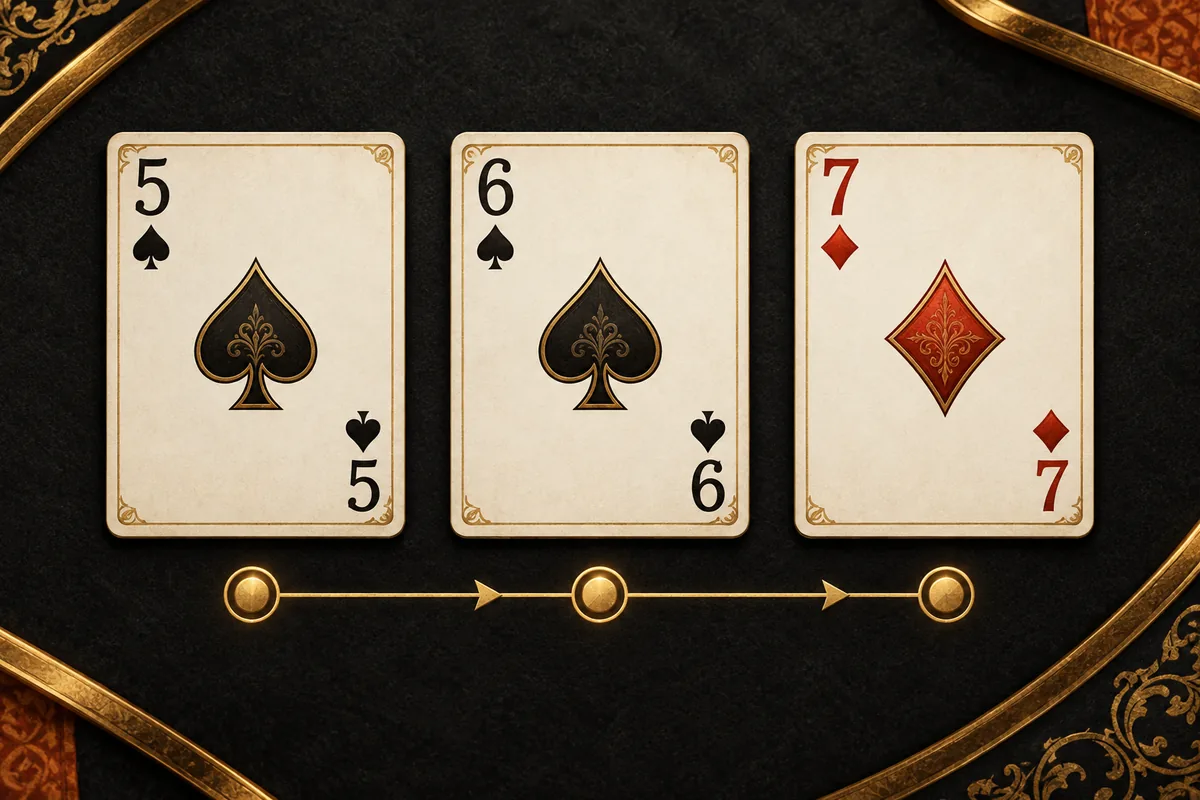
Compare that hand with A♥ Q♥ 8♥. The sequence wins over the colour. This is another category-first result: the ace and queen cannot lift a flush above a run under classic Teen Patti rankings.
The hand 5♠ 6♦ 8♣ does not qualify. There is a missing seven, and sorting the cards differently does not fill the gap. A sequence is defined by its ranks, not by how close together they look on screen.
Four Hands That Beginners Commonly Misread
| Hand | Correct category | Misreading to avoid |
|---|---|---|
| Q♠ K♠ A♠ | Pure sequence | Calling it only a colour |
| Q♥ K♦ A♣ | Sequence | Rejecting it because the ace is high |
| K♣ A♦ 2♥ | High card | Treating ranks as a wraparound circle |
| 4♣ 4♦ K♥ | Pair | Letting the king define the category |
For each hand, explain both why its category applies and why a stronger category does not. That small exercise builds more reliable recognition than memorizing an order without understanding its conditions.
For the short answer to “Is QKA a sequence?”, see QKA and AKQ: the same ranks in reverse order. For equal-ranked hands, use the separate Teen Patti tie rules.
Turn the List into a Practical Check
Before comparing hands, confirm the mode. Then identify the strongest category each hand satisfies, apply its rank comparison, and consult the settlement rule only if strength remains equal. This sequence keeps classification errors separate from disagreements about the table’s procedures.
Practise with face-up cards and no-money counters before adding timed decisions. Knowing the rankings helps explain outcomes, but it does not guarantee a win or justify increasing spending after losses. Treat the chart as a learning tool, not a prediction system or an endorsement of any download carrying a familiar name.
Looking for the full hand-ranking chart?
Trail > Pure Sequence > Sequence > Colour > Pair > High Card is the order of the six categories. The 12 rows above rank runs within a category. For other hand types and same-category comparisons, use the complete hand-ranking chart and tie-rule examples.
Sources
Rule and product references checked on 21 September 2026.