

Does having more jokers make your hand stronger?
Compare A♥ 9♦ 9♠ with 4♣ K♦ 8♠, assuming full rank substitution. The first hand uses one joker to make 9-9-9; the second uses two to make 8-8-8. The nines win. Joker count is not a separate rank.
This example has no natural-versus-wild tie: the completed ranks differ. Use the table’s special tie rule only when the finished hands have equal strength.
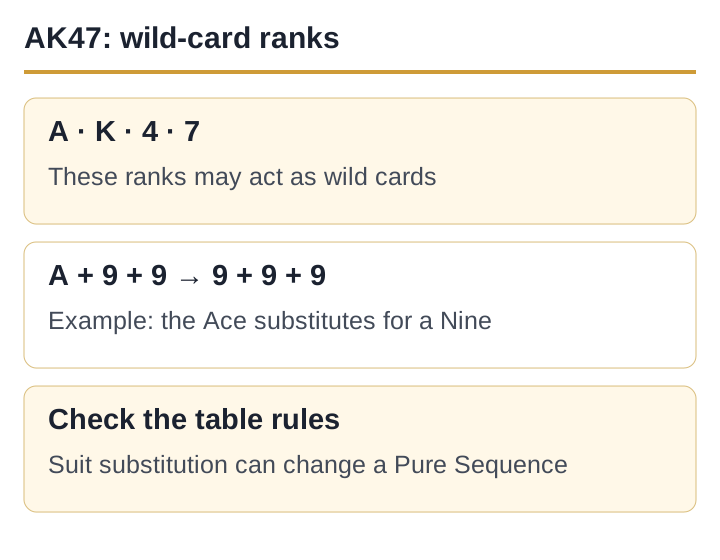
A + K + 4 + 7: four wild ranks
A standard deck has four suits for each named rank, so AK47 contains 16 potential wild cards. A dealt wild card may commonly represent another rank to complete the best hand allowed by the table.
The printed value is not automatically the final value. With 9♠-9♦-K♣, the King may represent a third Nine, producing a Trail of Nines. The game or dealer evaluates the completed hand; players should not compare the printed King as a kicker.
AK47 hand examples, from Trail to Pair
| Cards dealt | Wild use | Completed hand |
|---|---|---|
| 9♠ 9♦ K♣ | King becomes a Nine | Trail of Nines |
| Q♥ K♠ 7♦ | King and Seven become Queens | Trail of Queens |
| 8♠ 9♦ 4♣ | Four becomes Ten | 8-9-10 Sequence |
| 10♠ 6♦ K♥ | King becomes Ten | Pair of Tens |
When two wilds sit with one natural card, a Trail is often available: Q♣-A♦-7♠ can become Q-Q-Q. It should not be scored only as a Pair if the table permits both wild cards to copy the Queen.
These hands assume a full wild can copy the required rank. Pure Sequence and all-wild treatment need an additional house rule; they are not safe to infer from the name AK47.
Pure Sequence depends on whether a wild can copy a suit
King is wild
Explore other Teen Patti variations
Pure Sequence
Some implementations allow the King to become 10♥ even though it was dealt as a club. Others let a wild copy only a rank, downgrade a wild-assisted run, or give a natural hand priority. The table must answer this before the example can be scored.
If a completed hand can be either Colour or Pure Sequence, the higher valid category is normally used. But “normally” is not a substitute for the live evaluation rule.
AK47 changes card identity, not necessarily the category ladder
| Standard order | What AK47 changes |
|---|---|
| Trail / Trio | Wilds can complete matching ranks |
| Pure Sequence | Depends on suit-copy rule |
| Sequence | Wilds can fill a missing rank |
| Colour | Depends on whether a wild may adopt a suit |
| Pair | One wild can match a natural card |
| High Card | Less common when wilds are present |
Natural 9-9-9 and wild-assisted 9-9-K may complete the same Trail. A table may treat them equally, prefer the natural hand, or use a show-request rule for an exact tie. There is no safe universal tie rule.
Three wild cards create the same problem at a larger scale. Do not assume they automatically become the highest Trail unless the table describes its all-wild evaluation.
How often does a three-card hand contain an AK47 wild?
Under a standard 52-card deck with all 16 A, K, 4 and 7 cards wild, 36 cards are non-wild. The chance of receiving at least one wild is the complement of receiving three non-wild cards:
| Wild cards held | Combinations | Probability |
|---|---|---|
| 0 | 7,140 | 32.3077% |
| 1 | 10,080 | 45.6109% |
| 2 | 4,320 | 19.5475% |
| 3 | 560 | 2.5339% |
| Total | 22,100 | 100% |
This is a deal-frequency calculation, not a chance of winning. It does not decide how the software assigns a wild or how many opponents also hold one.
Four mistakes that change the result
- Making only one suit wild: the common AK47 convention names all suits of A, K, 4 and 7.
- Stopping at a Pair: two wilds with one natural card may complete a Trail.
- Reading printed ranks: compare the completed hand, not the faces left on the cards.
- Assuming natural-hand priority: the room must publish that tie rule.
AK47 checklist before the first deal
- Wild ranksConfirm that every A, K, 4 and 7 is wild.
- Suit substitutionCan a wild complete a Colour or Pure Sequence?
- Multiple wildsCan two or three wilds copy the same natural rank?
- All-wild handHow does the evaluator score three wild cards?
- Natural tieDoes a natural completed hand beat the same wild-assisted hand?
- Standard sequence orderCheck A-2-3 and A-K-Q before comparing runs.
Sources
References above checked on 21 September 2026.