
Royal is a label: check the actual deck
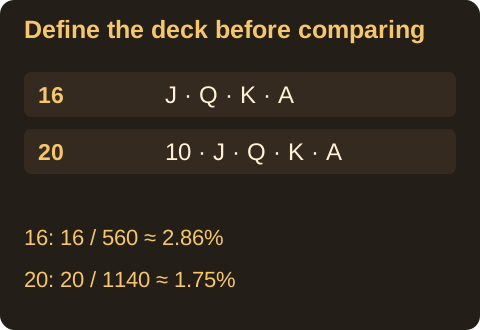
A Royal label can describe a shortened-deck variant or be part of an app’s name. It does not identify one universal set of cards. This guide uses two declared, counter-only teaching decks: J-Q-K-A in four suits (16 cards), and 10-J-Q-K-A in four suits (20 cards). Neither is presented as a verified live Teen Patti Gold or Master room. First establish the allowed ranks, joker policy and comparison order.
Count the deck before dealing
Four ranks times four suits gives 16 cards; five ranks times four suits gives 20. In a three-card-per-player exercise, six players need 18 cards. A 16-card deck cannot supply that deal without replacement; a 20-card deck can. Adding a second pack changes the sample space and permits duplicate physical identities, so it is a new model, not a harmless way to extend the calculation below.
A full probability calculation, not a promise
For one unordered three-card hand from the 20-card deck, there are C(20,3) = 1,140 possible hands. A trail uses one of five ranks and three of its four suits: 5 × C(4,3) = 20 trails. Therefore 20 ÷ 1,140 ≈ 1.75%. In the 16-card model the count is 4 × 4 = 16 trails among C(16,3) = 560 hands, or about 2.86%. These calculations assume a uniform shuffle, no jokers and no replacement.
A smaller deck does not mean every hand has a pair
In the 20-card model, an exact pair has 5 choices of paired rank, C(4,2) = 6 choices of its suits, and 16 choices of a different-rank kicker: 5 × 6 × 16 = 480 hands. Add the 20 trails and only 500 of 1,140 hands contain a repeated rank, about 43.86%. That is less than half. Some other hands are sequences or colours; “no pair” and “high card” are not synonyms.
Compare categories after checking membership
In the 20-card practice deck, A♠ Q♥ 10♣ is a high-card hand: it is mixed-suit and not consecutive. K♣ K♦ J♥ is a pair and beats it under ordinary category order. In the 16-card model, the first hand cannot even be dealt because 10 is absent. Do not classify an impossible hand and then use it as evidence about the chosen deck.
Two checks before changing decks
Can A-2-3 appear in either declared deck?
Reveal the explanation
No. Neither contains a 2 or a 3. A familiar Ace rule cannot create cards removed from the deck.
Does a 1.75% trail frequency mean a 1.75% chance of winning?
Reveal the explanation
No. It counts one hand category in a specified random deal. Winning depends on opponents’ cards and the actual comparison rules; the calculation is not a forecast of the next hand.
Use this as a rules worksheet
Write down the retained ranks, deck count, cards per hand, joker status and tie convention before practising. No Royal app download, bonus or availability claim is made here. The calculation illustrates why precise deck definitions matter.