

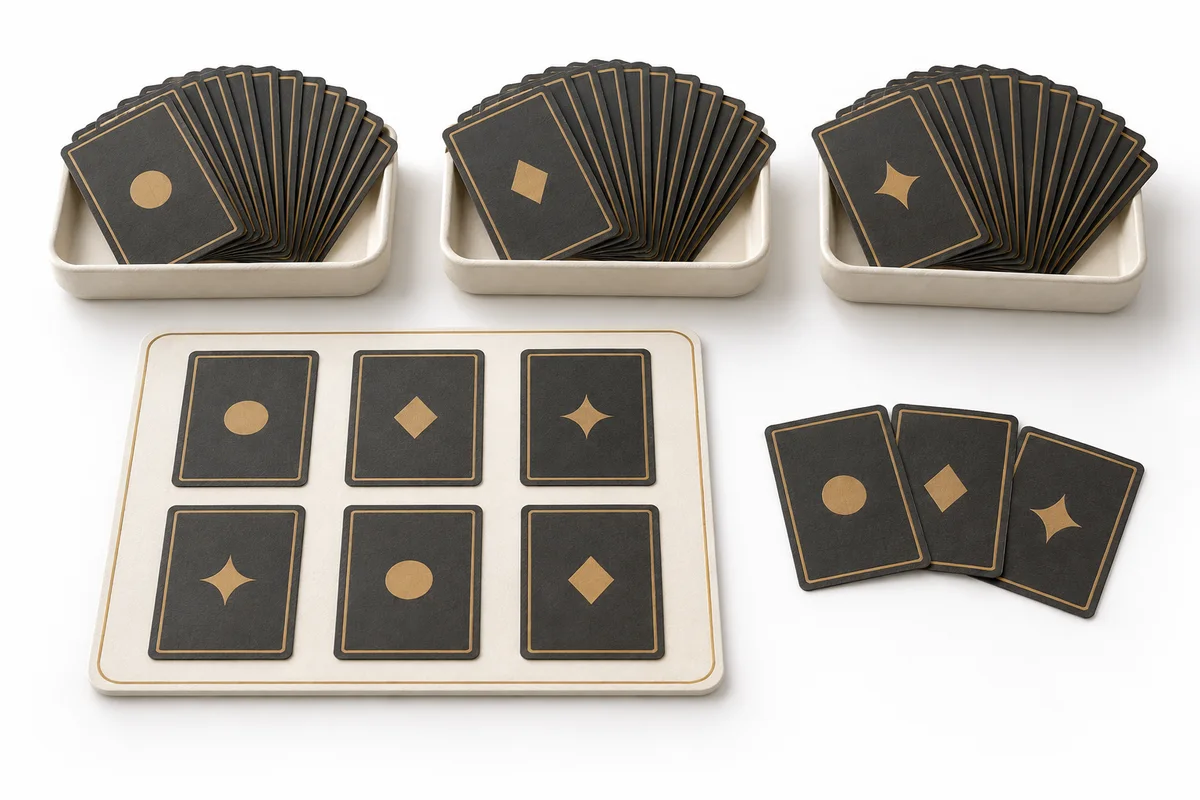
That makes Teen Patti a reasonable first choice for learning basic hand recognition, but not automatically the easiest game to play well. Fewer cards do not remove uncertainty, and a simple first lesson does not guarantee simple decisions later.
This comparison uses classic Teen Patti, 13-card Indian rummy, and standard high-hand Texas Hold’em. Other formats change the rules. It compares the games themselves, not the current availability of particular tables inside Teen Patti Gold or any other application.
Three Games, Three Different Tasks
| Question | Indian rummy | Texas Hold’em | Teen Patti |
|---|---|---|---|
| Starting private cards | Thirteen | Two | Three |
| Main card task | Build permitted groups | Select the strongest five | Classify the three-card hand |
| Can cards change? | Draw and discard on turns | Shared board develops; hole cards stay fixed | Ordinary dealt hand stays fixed |
| Shared board? | No | Up to five cards | No |
| Typical end condition | Valid declaration | Everyone else folds or showdown resolves the pot | Everyone else folds or a comparison resolves the round |
| First learning challenge | Group validity | Best-five selection | Category order |
One habit does not transfer neatly across all three. A set is part of an arrangement in rummy, a ranked combination in poker, and a different-sized combination in Teen Patti. Start by asking what the game requires you to do with the cards.
Rummy: Build a Complete Arrangement
In the common 13-card format, a player draws a card and discards one while working toward valid sequences and sets. A declaration needs at least two sequences, including a pure sequence, with the remaining cards also arranged in allowed groups.
A natural sequence uses consecutive ranks in the same suit. A set groups matching ranks in different suits. A joker can substitute in permitted groups, but it does not eliminate the requirement for a pure sequence. Check any special treatment of a designated wild card used at its natural value.
Consider this complete arrangement with no listed card designated wild:
| Group | Cards | Function |
|---|---|---|
| A | 5♣ 6♣ 7♣ | Pure sequence |
| B | 9♥ 10♥ J♥ Q♥ | Pure sequence |
| C | 4♣ 4♦ 4♠ | Set |
| D | K♣ K♦ K♠ | Set |
There are thirteen cards, two qualifying sequences, and no leftover card. The kings do not “beat” the fours within the arrangement; both sets help meet the declaration structure. Replace 7♣ with 7♦ and Group A breaks, even though the replacement has the same rank.
Poker: Select the Best Five Cards
Texas Hold’em begins with two private cards per player. The flop adds three shared cards, followed by the turn and river, each adding one. Betting occurs at the relevant stages, unless the hand has already ended.
At showdown, each player selects the best five-card hand from the seven available cards. Using both private cards is optional: the best hand may use two, one, or neither. The ordinary high-hand ranking determines the winner, with suitable kickers breaking same-category comparisons.
Suppose the board is K♣ K♦ 9♥ 6♠ 2♣. Tara holds A♦ Q♦; Ishan holds A♥ J♥. Their best hands are K-K-A-Q-9 and K-K-A-J-9. The paired kings and ace kicker match, but Tara’s queen beats Ishan’s jack.
The six and two do not add points, and a sixth card cannot break a five-card tie. This is a selection problem, not a requirement to arrange all seven available cards.
Teen Patti: Evaluate the Hand You Were Dealt
Classic Teen Patti gives each player three cards. Players may be blind, meaning they have not looked, or seen, meaning they have. They continue by contributing under the table’s rules or pack to leave the round.
The usual category order is trail, pure sequence, sequence, colour, pair, and high card. For instance, 6♣ 6♦ 6♥ beats 10♠ J♠ Q♠ because a trail outranks a pure sequence. The higher individual ranks in the second hand do not override the category order.
Unlike rummy, you cannot normally discard one card and draw another. Unlike Hold’em, no shared board arrives to improve your combination. What develops during the round is the information from actions and the cost of staying involved, not the original three-card hand.
Familiar Words Can Mean Different Things
A rummy sequence needs one suit, while an ordinary Teen Patti sequence can be mixed-suit. In Hold’em, five consecutive ranks form a straight, and all five being one suit makes a straight flush.
“Blind” also differs. In Teen Patti it describes not having seen your cards. In Hold’em, the small and big blinds are forced contributions associated with positions at the table; players may still look at their hole cards.
Finally, three matching ranks are not universally stronger than a run. Teen Patti places trail above sequence. Standard five-card poker places a straight above three of a kind. Rummy does not rank a set against a sequence to determine whose arrangement is stronger; it checks whether the declaration satisfies its requirements.
Scoring and Winning Are Different Questions
Rummy commonly uses penalty points. Aces and face cards often count ten, numbered cards their face value, and jokers zero. Which cards count against a losing player depends on completed groups, mandatory sequences, and the format’s scoring rules.
Poker and Teen Patti instead contest pots during ordinary play. Card ranks determine eligible hand comparisons; they are not added into a numeric score. A pot awarded to a player also includes that player’s own contributions, so the award is not identical to net gain.
For example, a practice pot containing fifteen counters may include five contributed by the winner. With no fee, the winner’s net increase from that round is ten counters. This arithmetic says nothing about how strong the hand was or whether the next round will go the same way.
Which Game Is Easier for Your Learning Style?
| If you enjoy… | A useful starting point | What to learn next |
|---|---|---|
| Recognizing a small number of patterns | Teen Patti | Blind/seen costs and show rules |
| Sorting and rearranging combinations | Rummy | Joker use and declaration checks |
| Comparing possibilities as shared information changes | Hold’em | Betting order and exact best-five comparisons |
These are teaching suggestions, not measured rankings of player ability. Someone comfortable with pattern puzzles may find rummy more intuitive despite the larger hand. Someone familiar with poker terminology may need less time on Hold’em’s first lesson.
Separate three milestones: knowing the legal actions, reading outcomes correctly, and making decisions under uncertainty. Reaching the first milestone does not mean you have reached the third.
A Three-Session Practice Plan
In the first session, use face-up Teen Patti hands and compare categories without betting. Explain why a low trail defeats a high pure sequence, then compare two pairs using their kickers. Add blind and seen contributions only when the comparisons are clear.
In the second, lay out a thirteen-card rummy hand and identify which groups are already valid. Suggest one helpful draw and the discard that would follow. Count every card once; a card cannot finish two groups simultaneously.
In the third, lay out a Hold’em board and two players’ hole cards. Write each player’s exact best five. Change only the river and repeat the exercise to see whether the winning combination changes.
Use non-cash counters and stop at a planned time. These exercises test understanding rather than reward-seeking. None of the three games should be treated as a reliable income source, and successful practice does not establish that an app is safe or that future results will be favourable.
Sources
Rule and product references checked on 21 September 2026.