
Stud describes exposed information, not one universal deal
Stud-labelled card games expose some cards while keeping others hidden. Publishers do not all describe the same number of cards or selection process under “Stud Teen Patti”. This article is therefore a reading exercise, not a claim that every Stud mode deals three cards or follows one betting schedule. Before opening a mode, check cards dealt, cards evaluated, exposed-card timing, jokers and showdown rules.
A visible queen is one fact
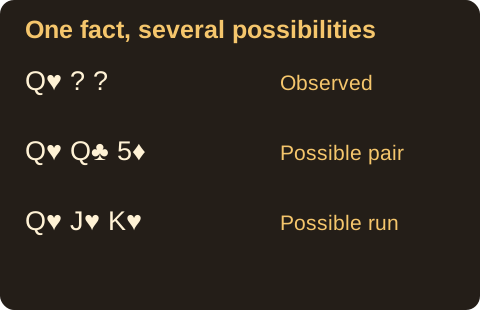
Imagine an exercise with a final three-card hand: Q♥ is visible and two cards are hidden. You know the queen is present. You do not know the hidden ranks or suits. It could be a high-card hand, a pair, or a stronger category. Do not report “pair of queens” unless the available evidence actually establishes a second queen. A confident opponent does not reveal a hidden card.
List possibilities without pretending to know them
If the exposed card is Q♥, hidden Q♣ 5♦ would create a pair; hidden J♥ K♥ would create a pure sequence; hidden 2♣ 7♦ would leave a high-card hand. These are three constructed completions, not equally likely forecasts and not cards we observed in an app. Their purpose is to show how different results remain compatible with the same public information.
Two visible cards can rule things out
For a final three-card hand without jokers, exposed 8♠ 9♠ could be completed by 7♠ or 10♠ into a pure sequence. Exposed 8♠ 9♥ cannot form a flush with just one additional card: the first two suits already differ. It can still form a mixed-suit sequence with a suitable seven or ten. This deduction relies on three cards being evaluated; it does not automatically hold when a larger hand lets the player discard an exposed card.
Your own cards change what remains
In a one-deck exercise without jokers, you hold 7♠ and an opponent exposes 8♠ 9♠. They cannot also hold that same physical 7♠. However, 10♠ may still complete their run, and other hidden cards may form other categories. Eliminating one completion is not proving the whole hand weak. With multiple decks or wild cards, even that exclusion must be reconsidered.
Keep notes in three columns
Write “observed”, “possible” and “excluded under these rules”. Put Q♥ exposed under observed; put a heart run under possible; exclude a flush only when fixed visible suits conflict with it in a three-card final hand. This separates a real rule deduction from a guess. Practise face up after each reveal and check whether the reasoning stayed within the agreed model.
Try the information test
An opponent exposes K♣ in a three-card no-joker hand. Must your pair of eights beat them?
Reveal the explanation
No. The hidden cards could make a higher pair, a trail of kings or another permitted stronger category. You have not observed enough to guarantee the comparison.
Two fixed exposed cards are 4♦ 5♣. Can one more card make a pure sequence?
Reveal the explanation
Not in a final three-card natural hand: the fixed suits differ. A joker or a mode that selects three from more cards changes the assumptions.
Use the right rule sheet
An exposed card is information, not a prediction of the next card or a reason to increase a stake. Keep these exercises counter-only. If the mode’s card count or selection rules are unclear, stop and read them before borrowing conclusions from this article. No Stud availability or device test is claimed for the site-provided APK.
Compare complete hands · Why card selection changes deductions · Compare variant rules