
Two players changes the practice setup
This guide is a two-person, counter-only learning exercise, not a promise that every app offers a heads-up table. Deal three cards to each player from one 52-card deck without jokers and agree a ranking and tie convention first. Unlike a group lesson, there is no third player left to act after one person exits. If either player packs, the comparison exercise ends rather than turning into solitaire.
Use a final show in this exercise
Treat the two remaining hands as a final comparison. We do not add a separate private sideshow stage to this practice model. Some products publish different action menus or minimum-player conditions, so confirm them rather than assuming a Sideshow button must exist. For the full Blind/Seen contribution model, use the linked guide; this page focuses on the heads-up finish and information available to each player.
Count one small pot without confusing it with the stake
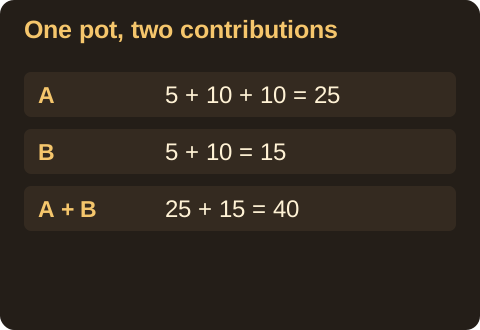
Assume both players are seen and the reference stake stays at S = 5 counters. Each starts with a boot of 5, giving pot 10. A contributes 10, pot 20. B contributes 10, pot 30. A then requests a show for 2S = 10 under the declared convention, making pot 40. A contributed 25 in total; B contributed 15. These unequal totals are not a bookkeeping error.
A category can beat the highest visible rank
At the finish, A has 4♣ 5♦ 6♥ and B has A♠ J♠ 8♠. A has a mixed-suit sequence; B has a nonconsecutive colour. Under the ordinary sequence-above-colour category order, A wins the comparison. The Ace does not reverse that category rule. If you apply a different variant, write that change before dealing rather than changing it after seeing the cards.
Equal ranks do not settle who receives the pot
A♠ K♥ J♦ and A♥ K♦ J♣ have the same ordered ranks and both are high-card hands. Their suits do not break this teaching comparison. For a declared show rule that awards an exact tie to the non-requester, B receives the 40 counters if A paid for the show. A split-pot house rule would produce a different settlement. Keep hand equality and pot settlement as two separate checks.
Do not treat one opponent as a known hand
There is only one other player, but their cards are still hidden until shown. A pause, a large counter contribution or a familiar pattern does not reveal a card rank. Practise by writing “known”, “possible” and “not established” beside observations. Turn the hands face up after the exercise and check the explanation instead of rewarding confident guesses.
Two heads-up checks
A has Q♠ Q♥ 4♦; B has J♠ J♥ A♣. Does B’s Ace win?
Reveal the explanation
No. Compare the pair rank first: queens beat jacks. The kicker matters only after the pair ranks tie.
Do two players require a download to practise the finish?
Reveal the explanation
No. A physical deck or the browser comparison tool is enough. Do not share accounts, OTPs or install an app on another person’s behalf for this exercise.
Choose the next lesson
Full contribution and show conventions · Compare your two hands · Work through equal hands